Listings at 93% completeness. Reviews replied to within hours. rStorefront, the hyperlocal funnel for 20+ Indian brands.
10 min read
·
Posted on Jul 01, 2026
Project
Website
Industry
Category
Year
Author

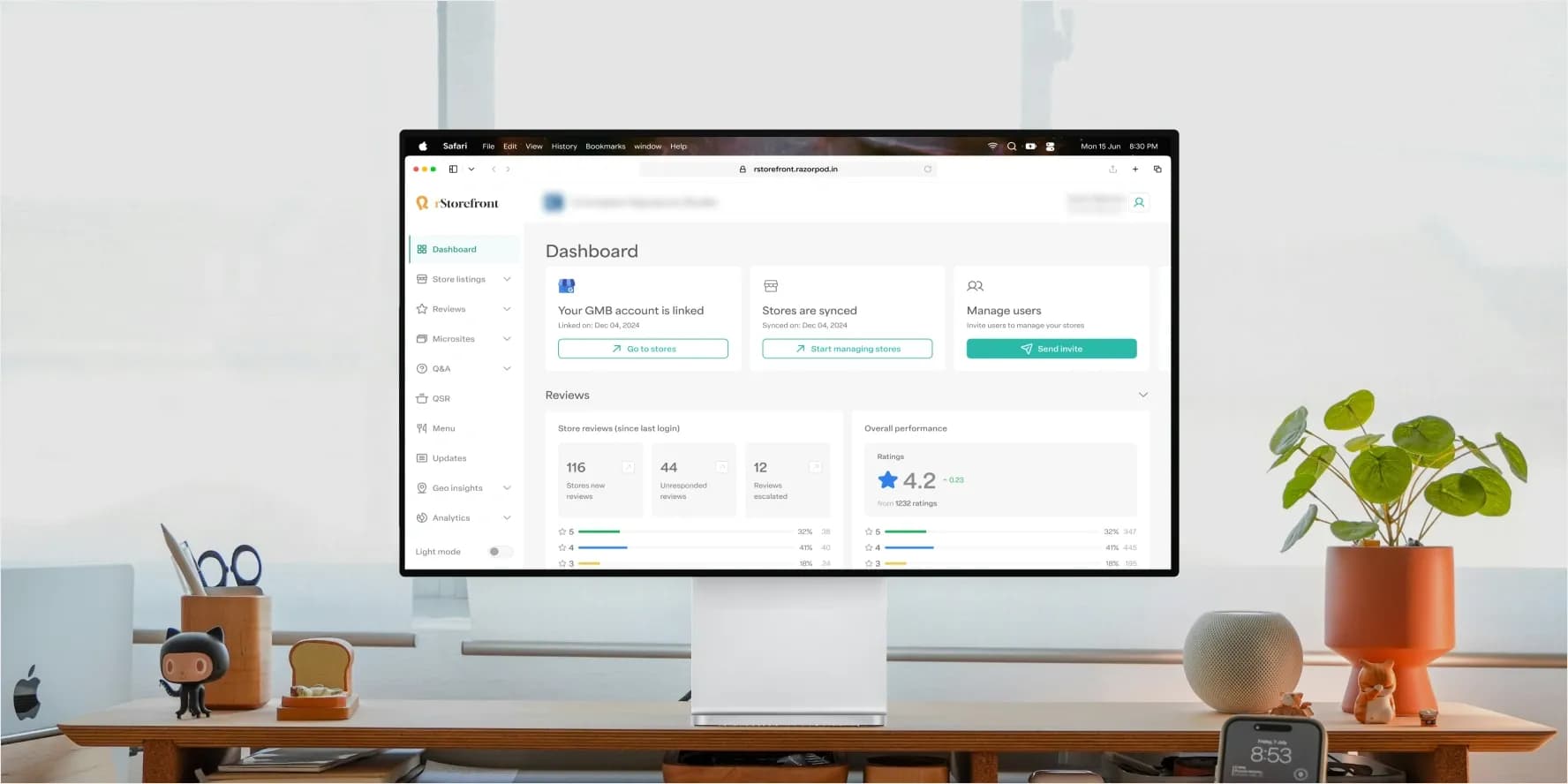
rStorefront is a hyperlocal presence platform for multi-location brands. It pulls every Google Business Profile a brand runs, from ten stores to four hundred, into one place to manage. Listings, reviews, microsites, virtual numbers, analytics. The work Google's native tools leave to spreadsheets once a brand crosses thirty locations.
We shaped what rStorefront became. Every pillar, designed end to end: the bulk engine that edits four hundred listings at once, the review system that replies in hours, the AI responder that shipped before Google's own, the microsite builder, the analytics that grew with how brands read their data. Strategy and interface, built together with the product team.
“ Today 20+ Indian brands run their presence on rStorefront. The platform earned that footprint. The design work is why it holds.”
What this delivered

8 product pillars, designed end to end.
Additional modules as AI responder, Geo Insights, Menu management & QSR.
Customer front and Admin for RetailFront, a hyperlocal e-Commerce platform.
1000+ screens delivered, for desktop-sm (1440) & desktop-lg (1920).
132 primitives, 327 tokens, 11 text styles, 174 icons, 50+ component sets.
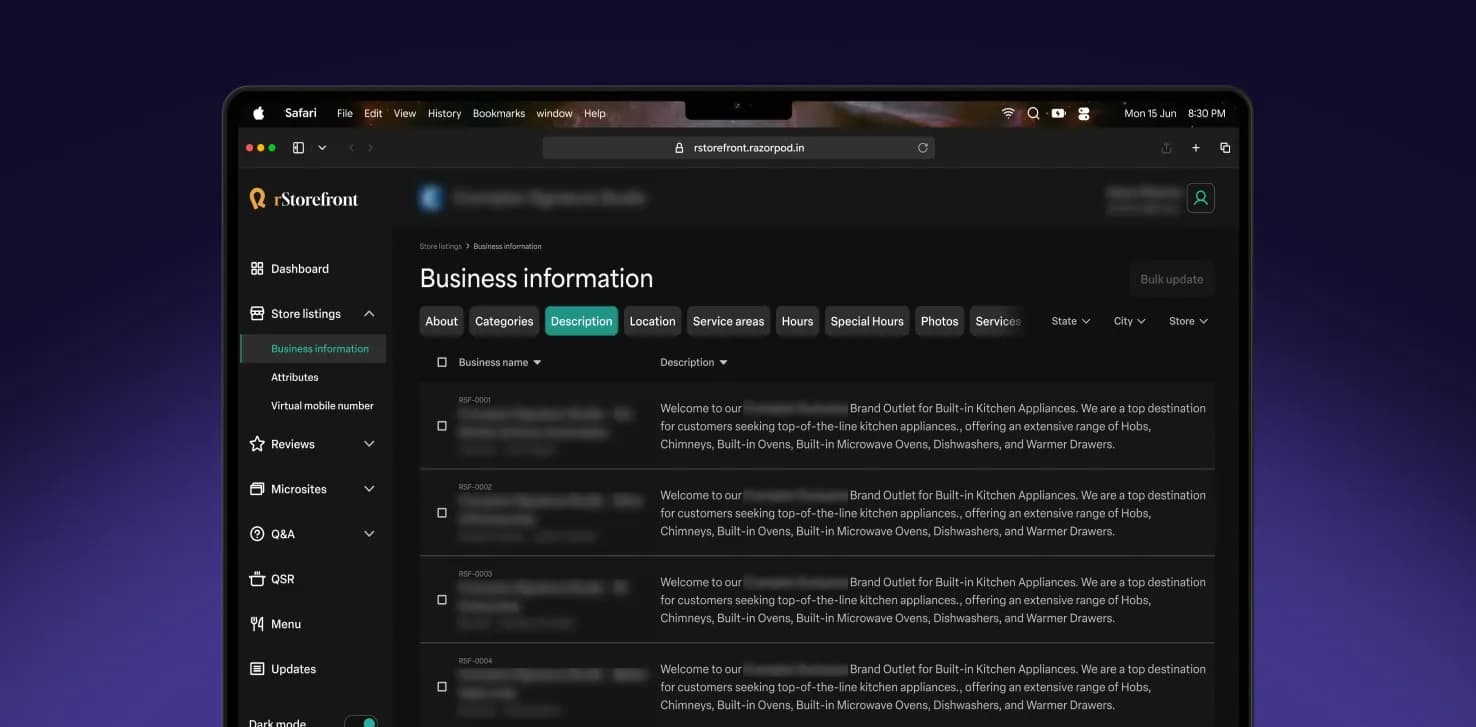
Light and dark from launch, scalable to additional themes.
Developed the platform in JavaScript, Laravel, PHP & more.
8 product pillars, designed end to end.
Additional modules as AI responder, Geo Insights, Menu management & QSR.
Customer front and Admin for RetailFront, a hyperlocal e-Commerce platform.
1000+ screens delivered, for desktop-sm (1440) & desktop-lg (1920).
132 primitives, 327 tokens, 11 text styles, 174 icons, 50+ component sets.
Light and dark from launch, scalable to additional themes.
Developed the platform in JavaScript, Laravel, PHP & more.

Building for a market the native tools weren't designed for
Google Business Profile is free. It surfaces business details across Search and Maps. For one location, the native interface works. For 400, it fragments.
Each location is its own review stream. Bulk operations are limited. Comparison across stores happens in spreadsheets, not the product. NAP consistency, duplicate suppression, role governance: each becomes an operations problem when scale crosses 30 locations.
The category isn't empty. Yext, Synup, MomentFeed, Birdeye and others sit in this space. Most are built for Western enterprise conditions: postcard verification on Western timelines, single-language customer bases, desktop-first usage patterns. None are built for India, where 80% of web traffic comes through mobile, reviews arrive in regional languages, and store counts at growing brands can swing from 10 to 400 in a year.
“ rStorefront was built for those conditions, by a team that lived them. ”
Five pillars, three capability layers
rStorefront is a platform with five named pillars. Three capability layers sit across them.
01
Listings
Every store's GMB Profile in one inventory.
02
Reviews
Every review across every store, in one place.
03
Microsites
A responsive website per store.
04
Virtual Mobile Number
A dedicated number per store.
05
Analytics
Across all four pillars, over time. From vanity metrics through to attribution.

AI Responder
for reviews, inline in the reviews table.
Geo Insights
for visibility by neighbourhood grid.
Vertical activation
for food service brands, with the Menu Module and QSR onboarding.
Designing listings work that scales from ten stores to four hundred
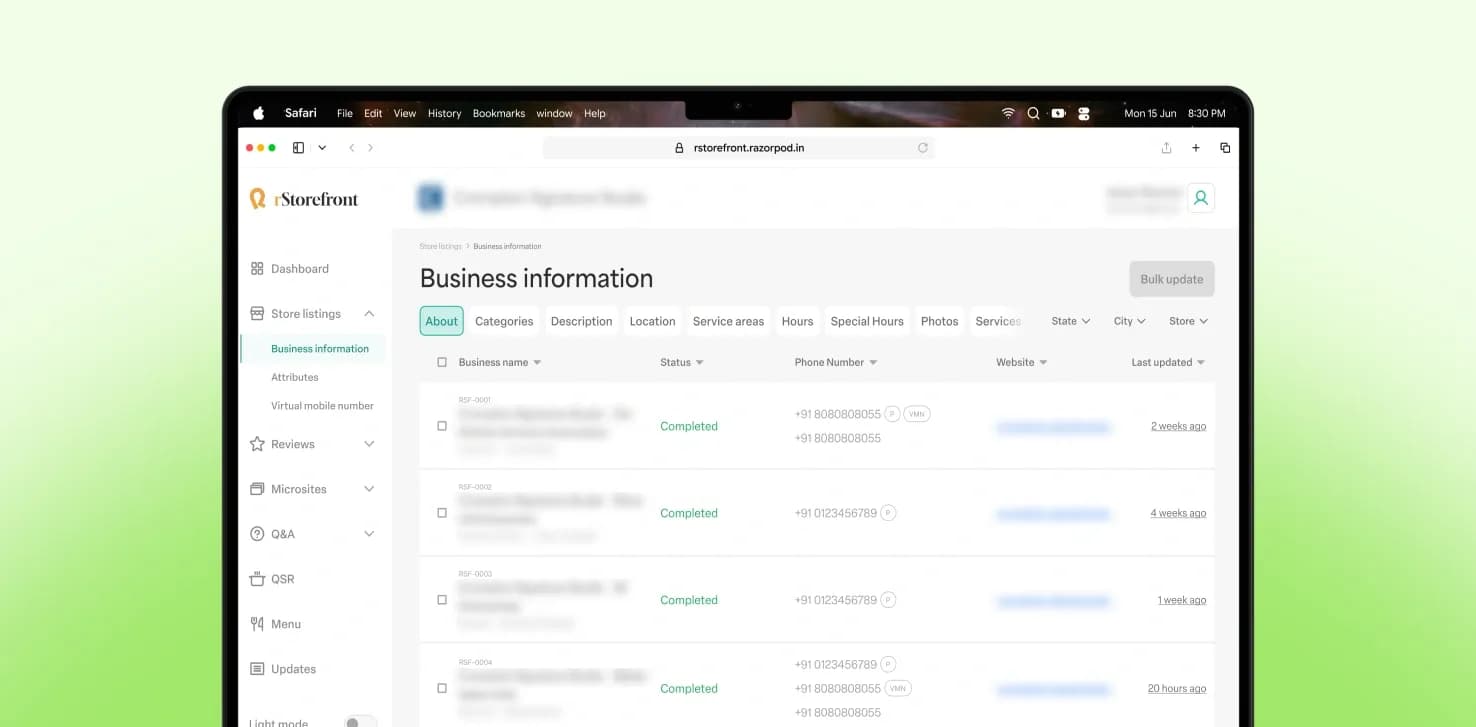
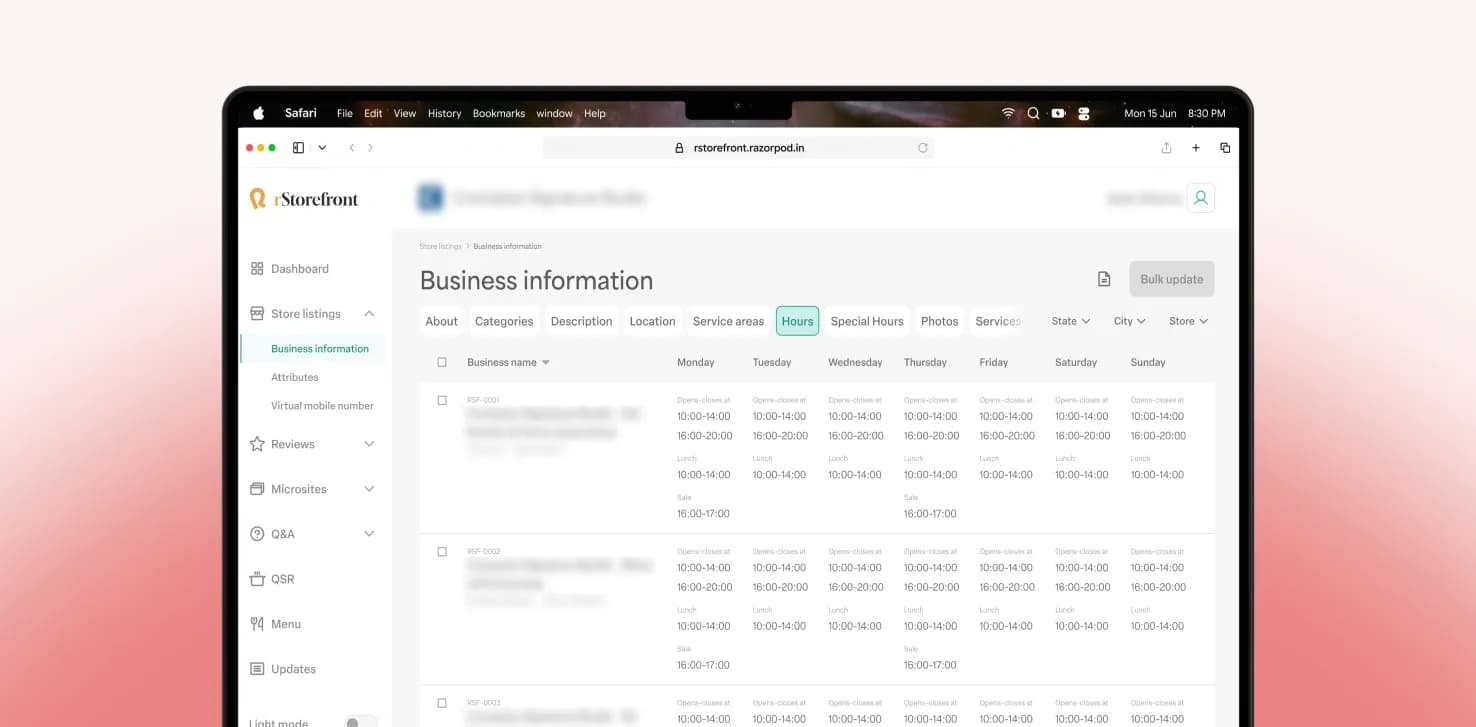
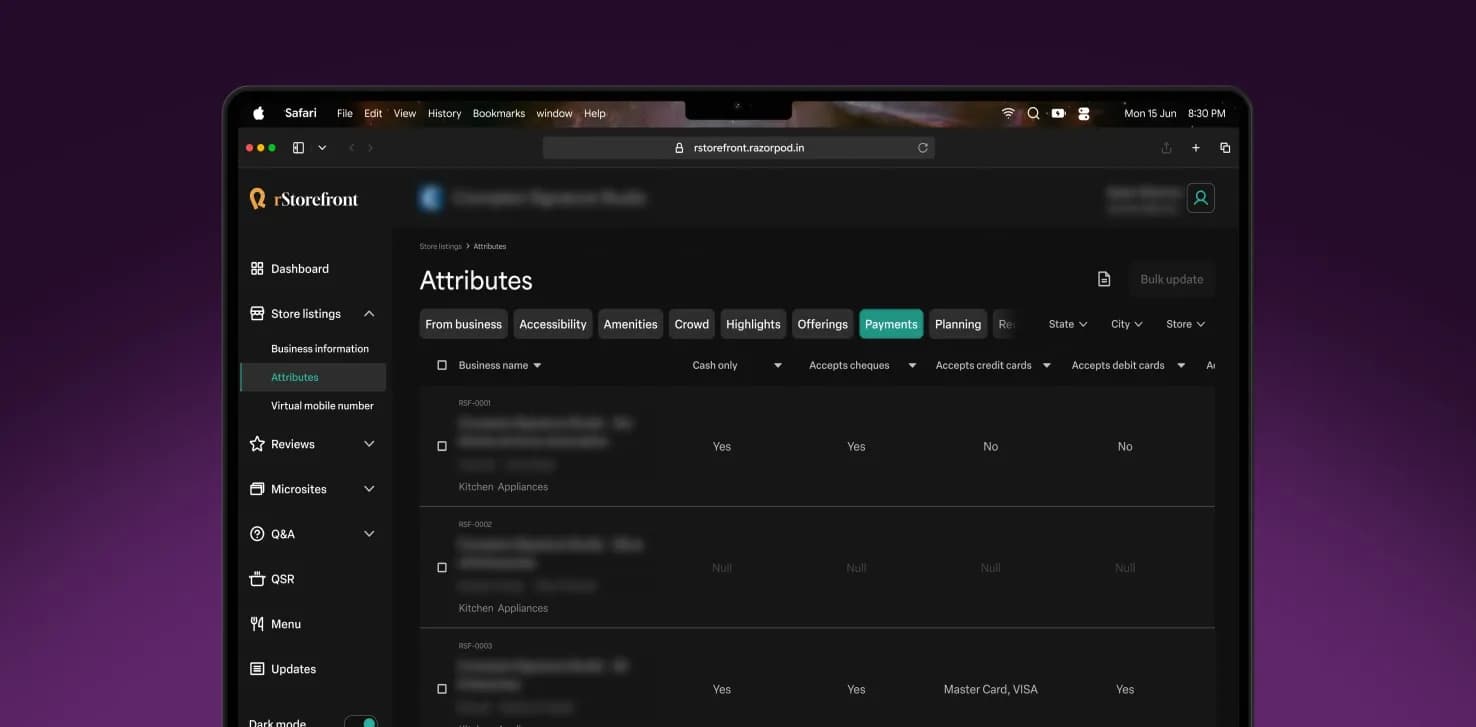
Listings is the spine of the product. Every customer uses it. Every customer's day-one problem is the same: hundreds of GBP entries with inconsistent business information, missing attributes, half-completed profiles.
The hard design problem wasn't "how to edit one listing." It was "how to edit attributes across 400 stores without making the user feel like they're editing 400 things one at a time."
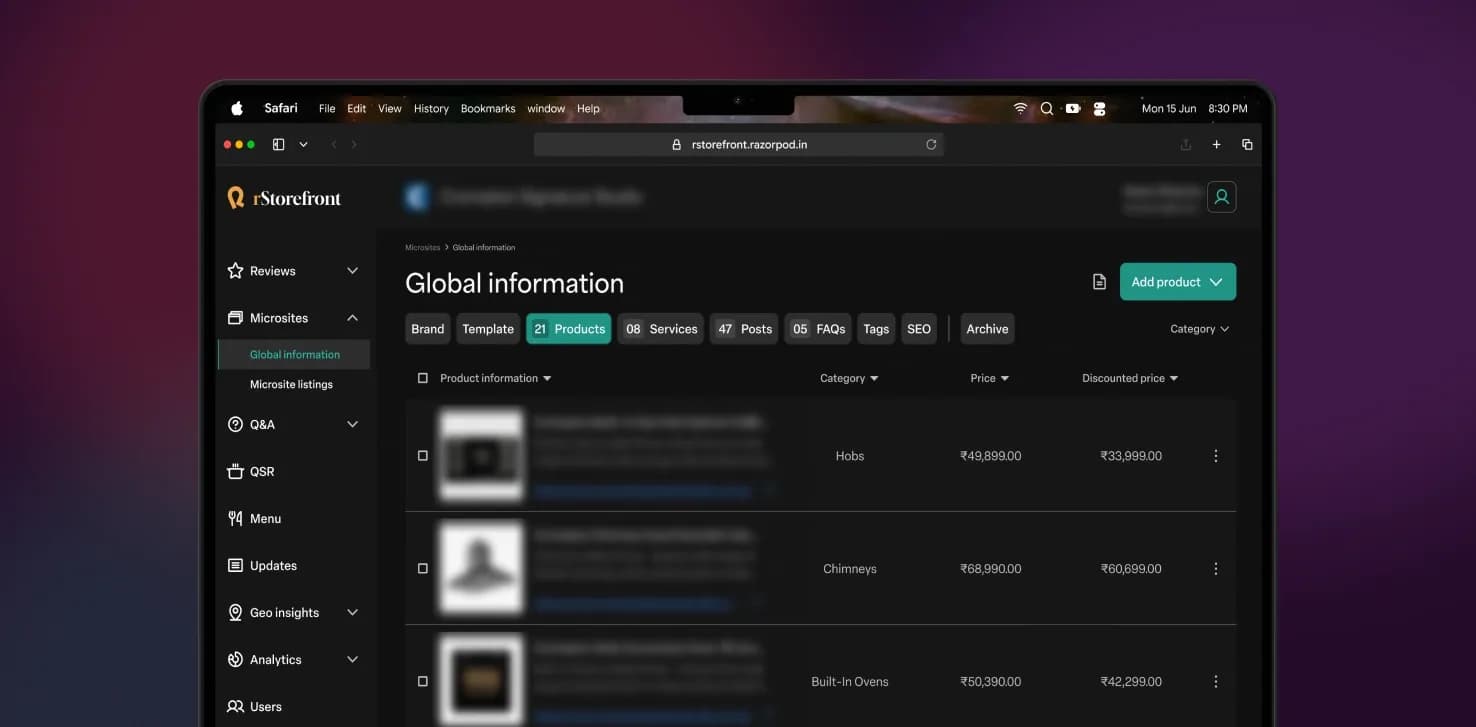
Bulk operations sit at the heart of the listings workflow. Photos, categories, attribute toggles, hours, holiday schedules: any field that varies across stores. Filters narrow the target set; updates apply to the filter; logs track what changed where. A side peek surface keeps each store's profile reachable without losing the bulk context.
“ 60% or more of all listing updates on rStorefront flow through bulk, not single-store edit. Profile strength averages 93% across managed listings, a number multi-location brands couldn't reach without bulk operations Google's native interface doesn't offer. ”
Listings management
Customer base, anonymised
20+ organisations, all currently in India. Industries observed across the customer base:
Consumer appliances (multi-state dealer networks).
Electric mobility (EV brands with growing dealer footprints).
Government-backed e-marketplaces.
Food service (QSR and casual dining chains).
Real estate (multi-listing brokerages),
Multi-brand showrooms.
Case studies on rStorefront

Customer Experience transformation
Industry
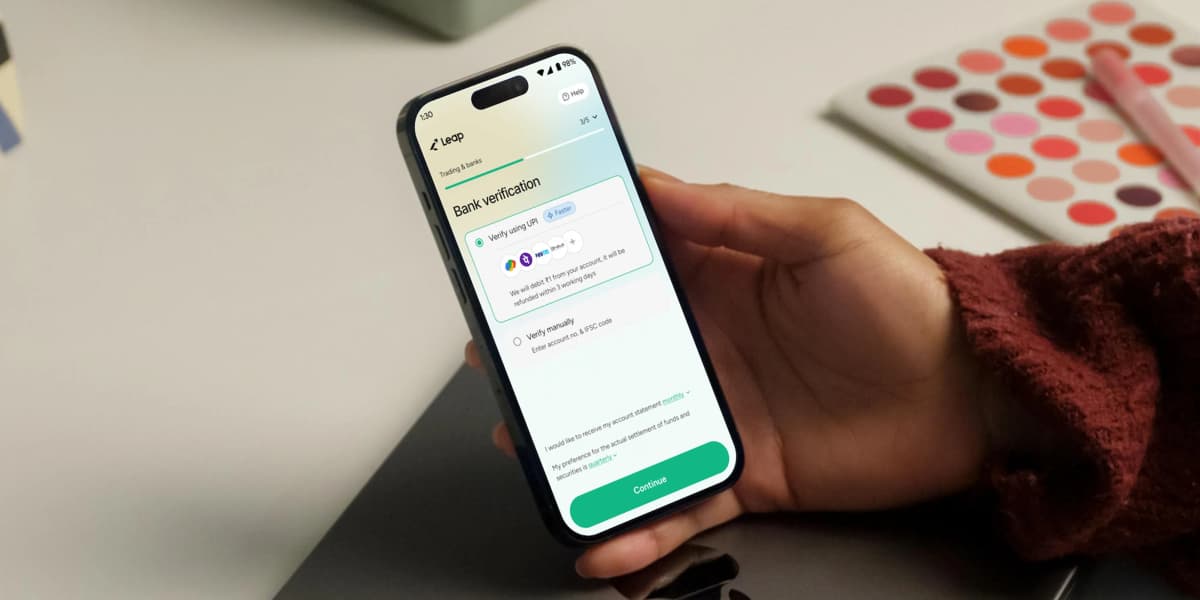
Full account opening in 4 minutes. Religare Broking's onboarding, rebuilt.
Industry
Replying to every review, hours not days
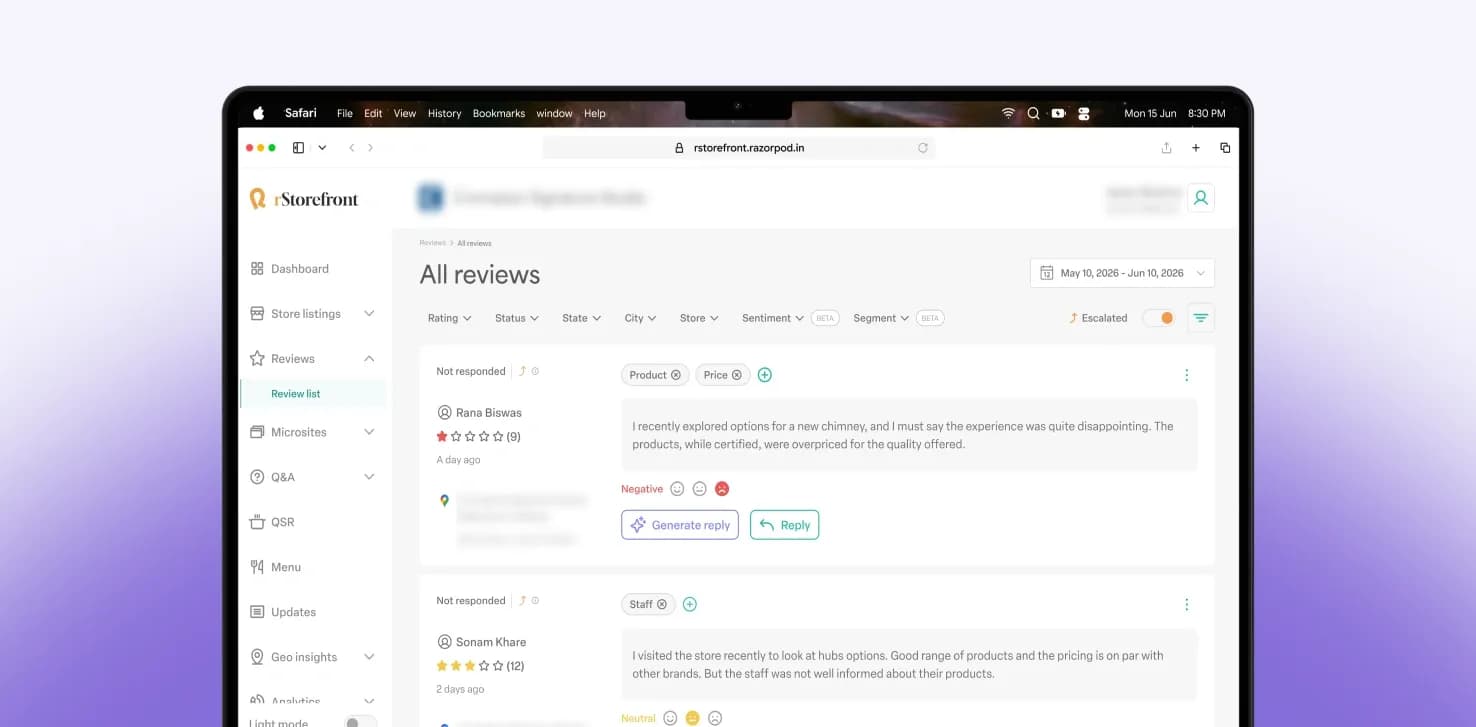
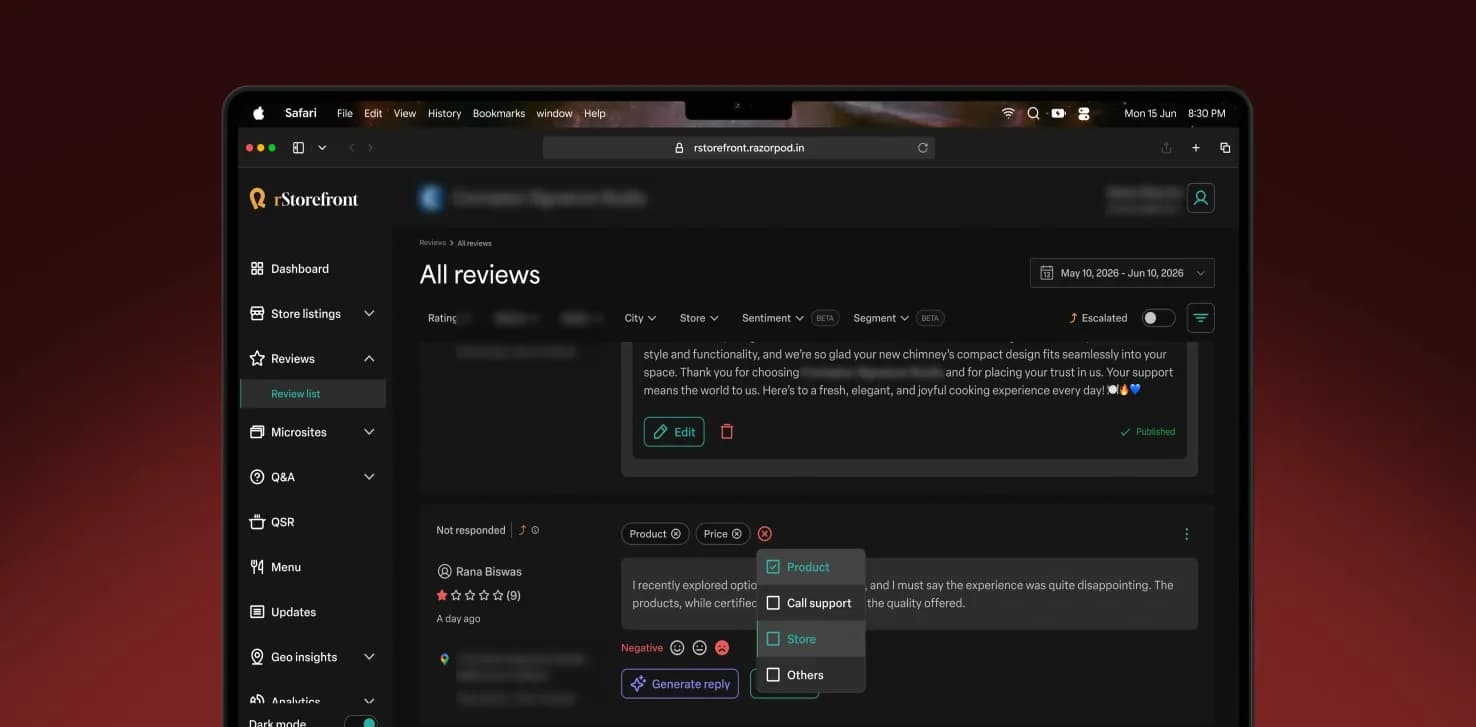
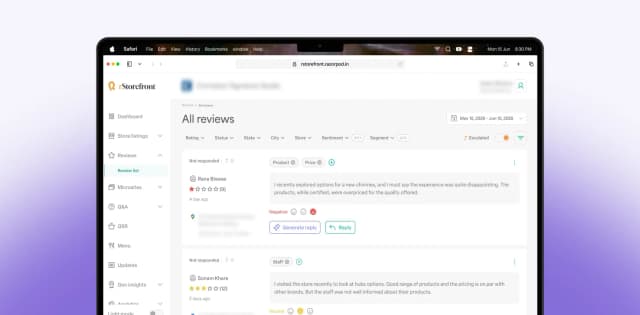
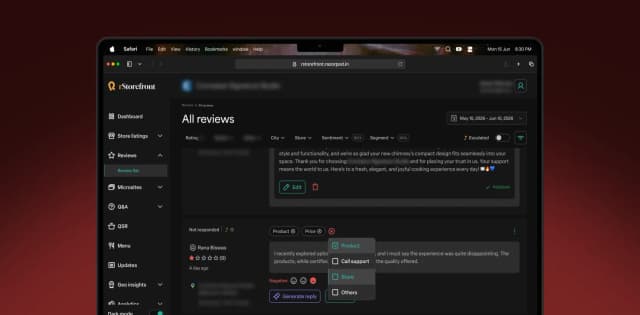
Reviews are where users speak, and where brands either show up or don't. The native interface lets one person reply to one review at a time, on one listing. Across 400 stores, that's 400 review streams to monitor.
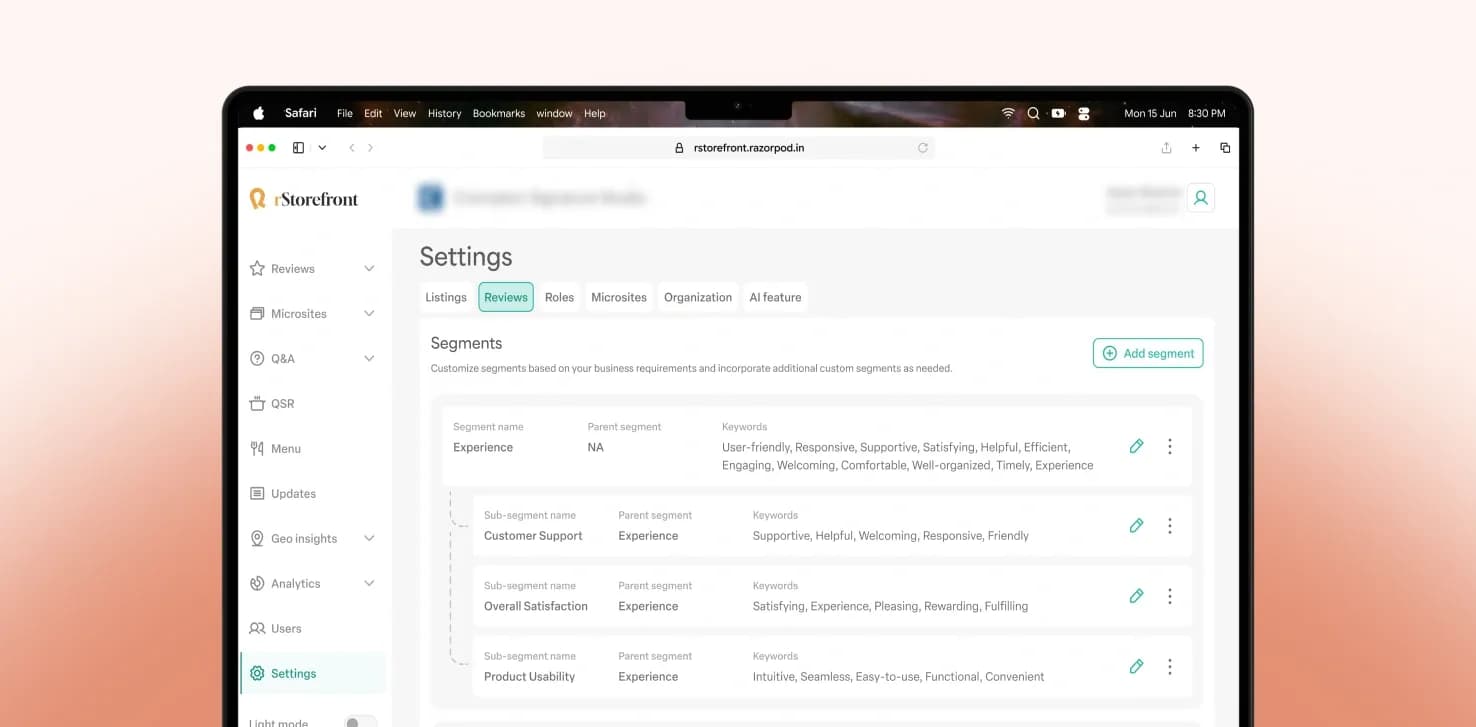
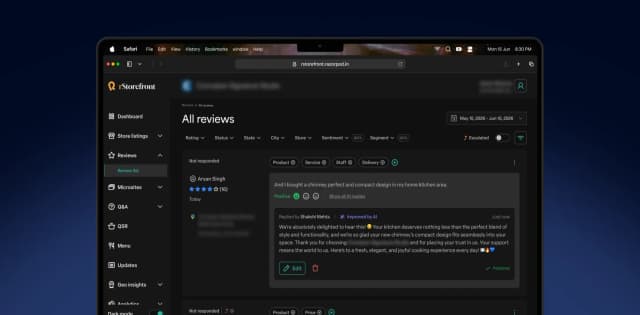
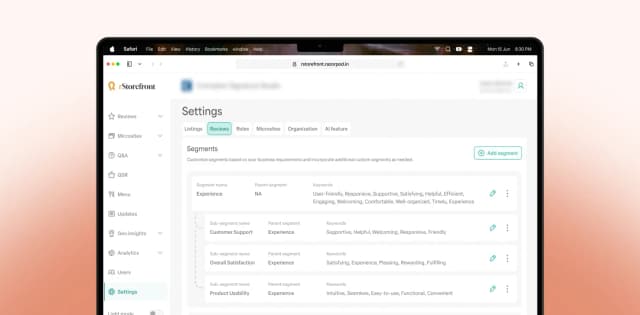
The reviews surface in rStorefront pulls every review across every store into one inventory. Sentiment tagging happens on receipt. Custom segments let brands cut reviews by what their business actually cares about: a hair salon by service category, a QSR by menu item, a real-estate agency by listing type. Escalation routes low-rated reviews to managers. Email workflow turns a flagged review into a back-channel resolution thread.
Bulk operations sit at the heart of the listings workflow. Photos, categories, attribute toggles, hours, holiday schedules: any field that varies across stores. Filters narrow the target set; updates apply to the filter; logs track what changed where. A side peek surface keeps each store's profile reachable without losing the bulk context.
60% or more of all listing updates on rStorefront flow through bulk, not single-store edit. Profile strength averages 93% across managed listings, a number multi-location brands couldn't reach without bulk operations Google's native interface doesn't offer.
Reviews management
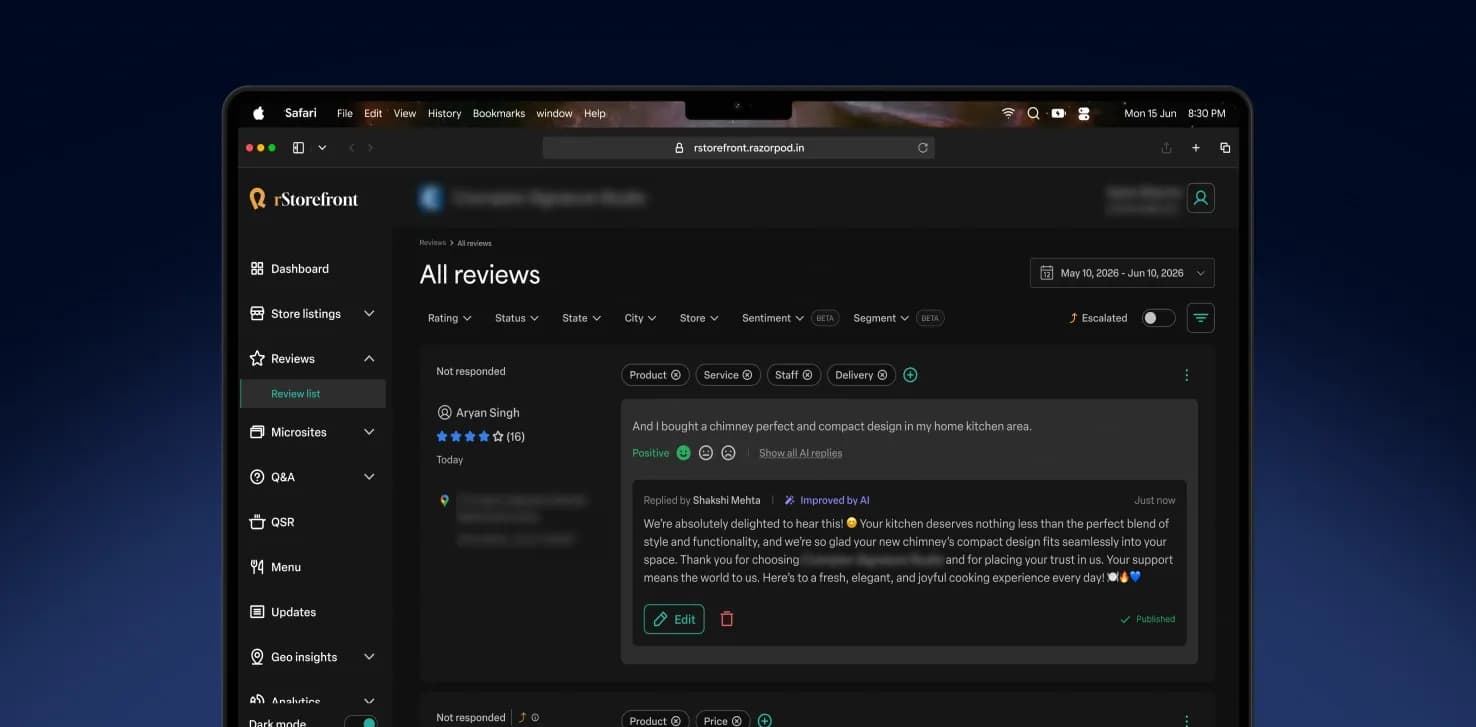
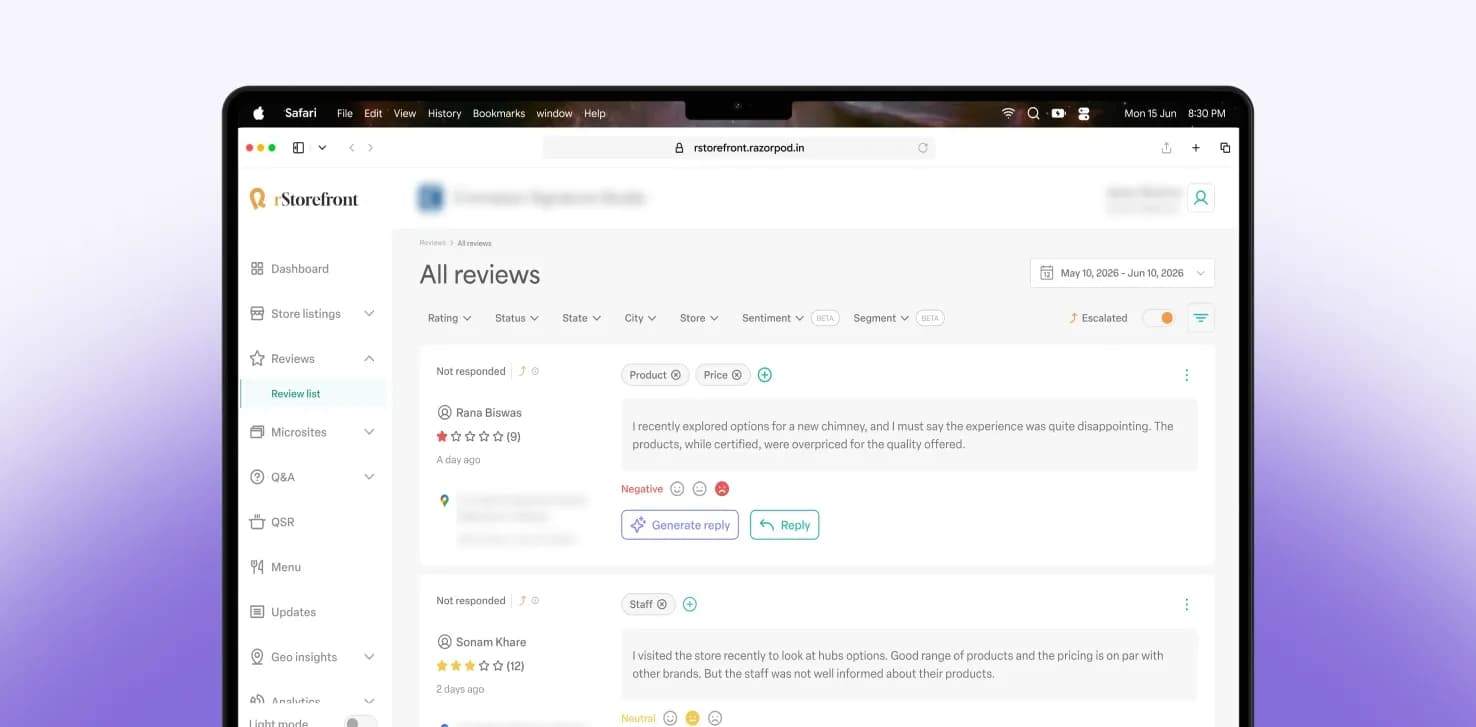
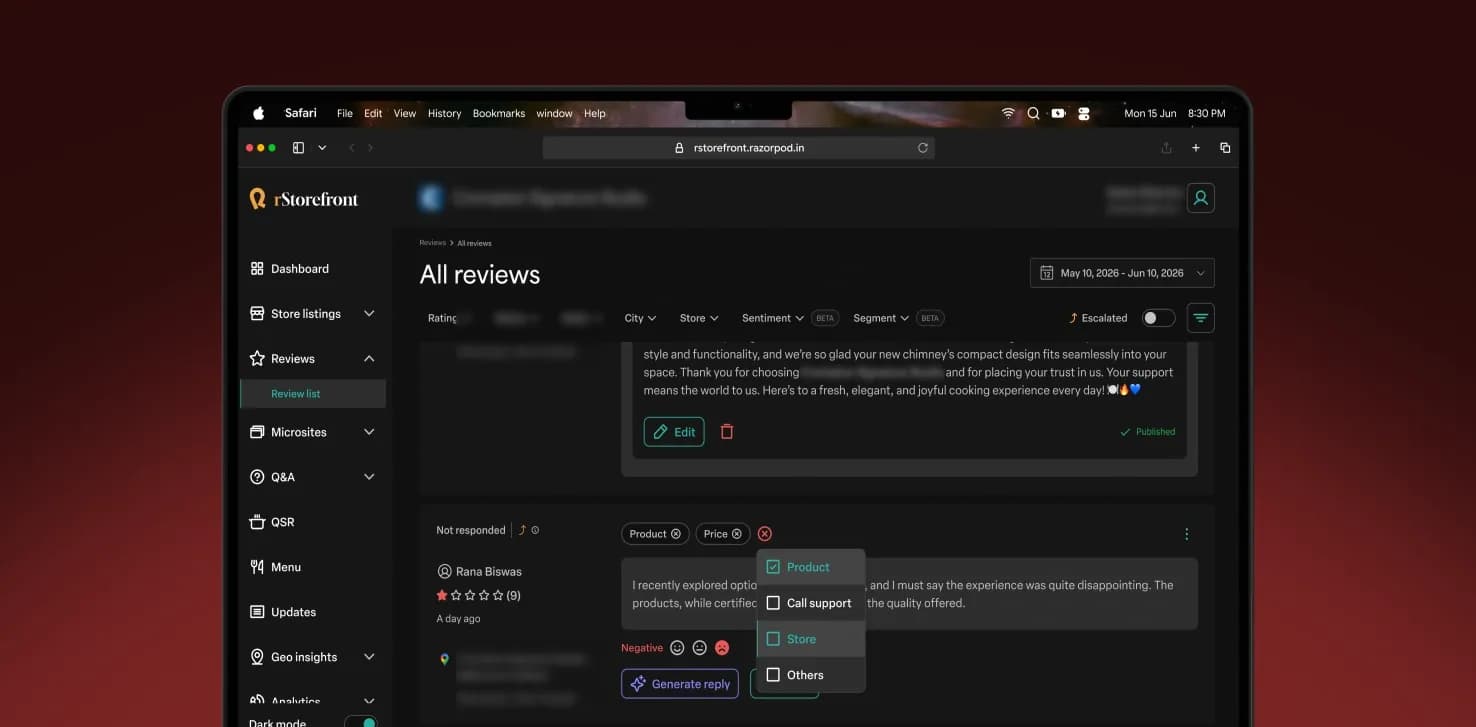
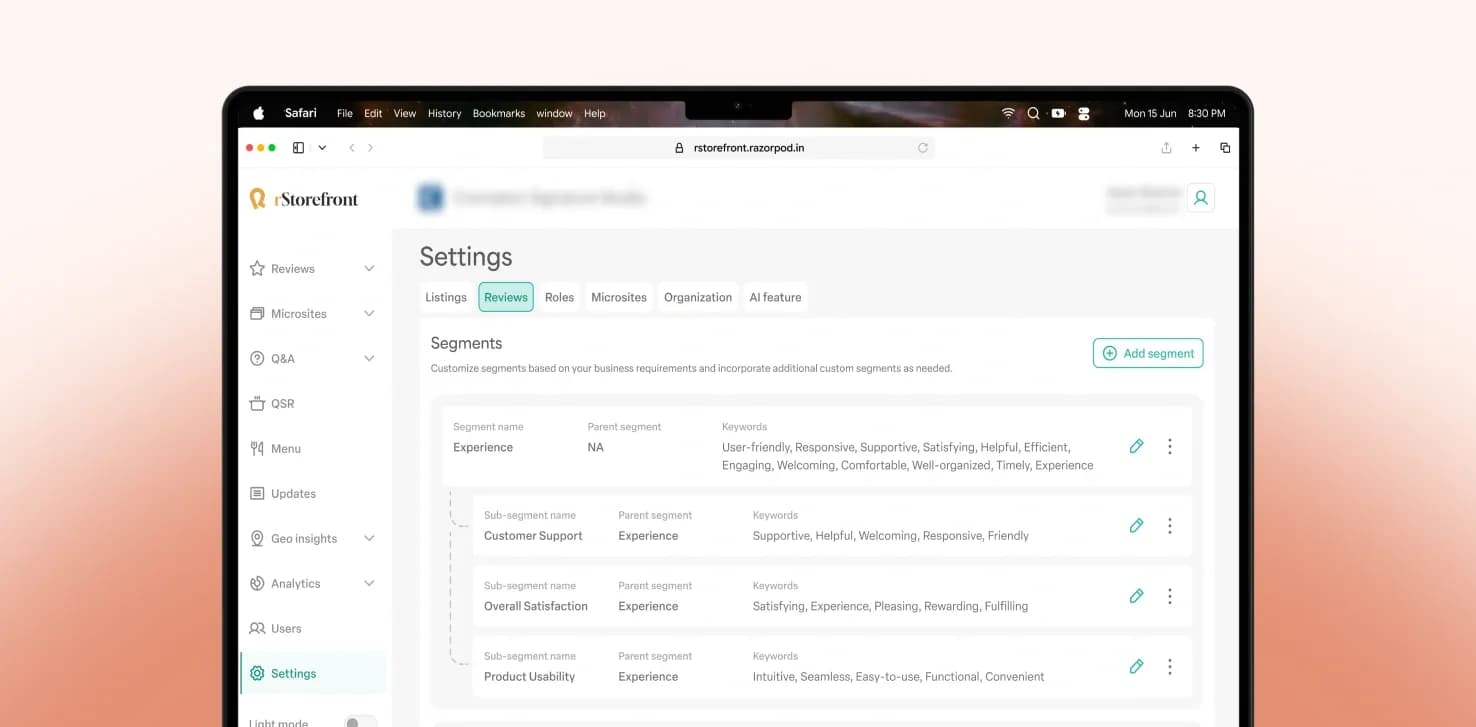
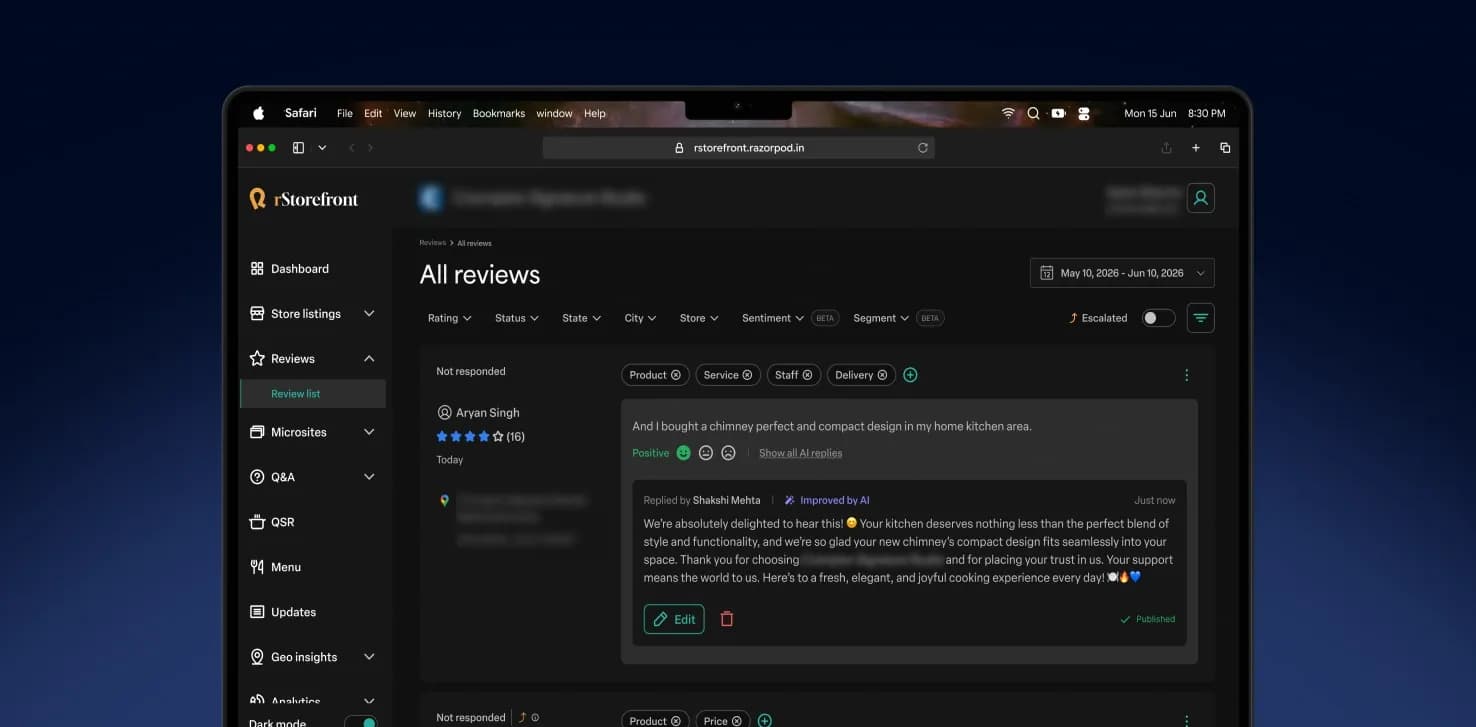
AI Responder sits inside the reviews table. For each unanswered review, a drafted reply appears inline, ready for owner edit or approval. The draft adapts to the review's sentiment, the customer's business category, and the brand's tone. It shipped in rStorefront before Google added a native equivalent.
Across the customer base today, AI Responder drafts are used for over 90% of review replies. Review response rate sits at 89%. Time-to-response is in hours, not days.
Publishing a website per store, mobile-first
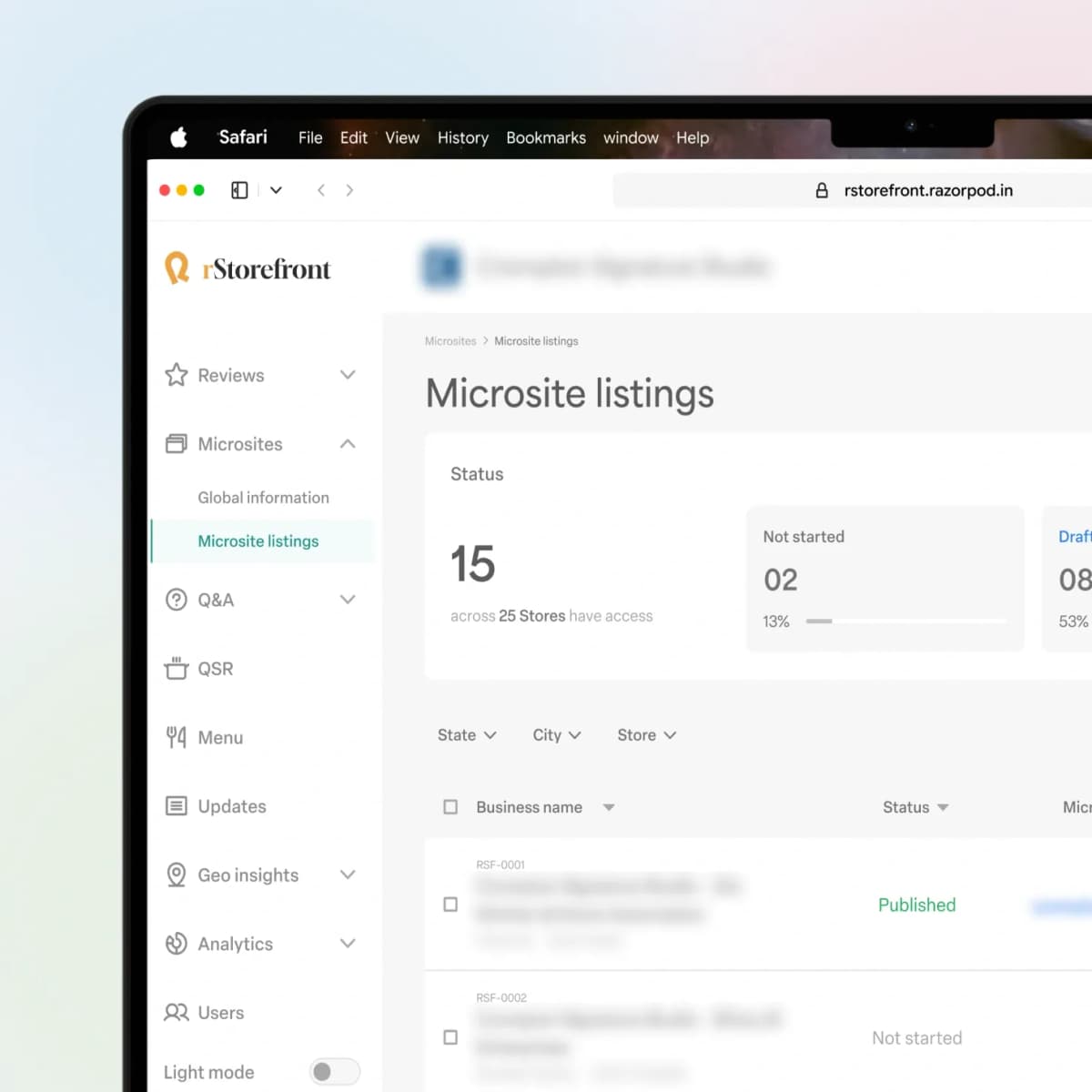
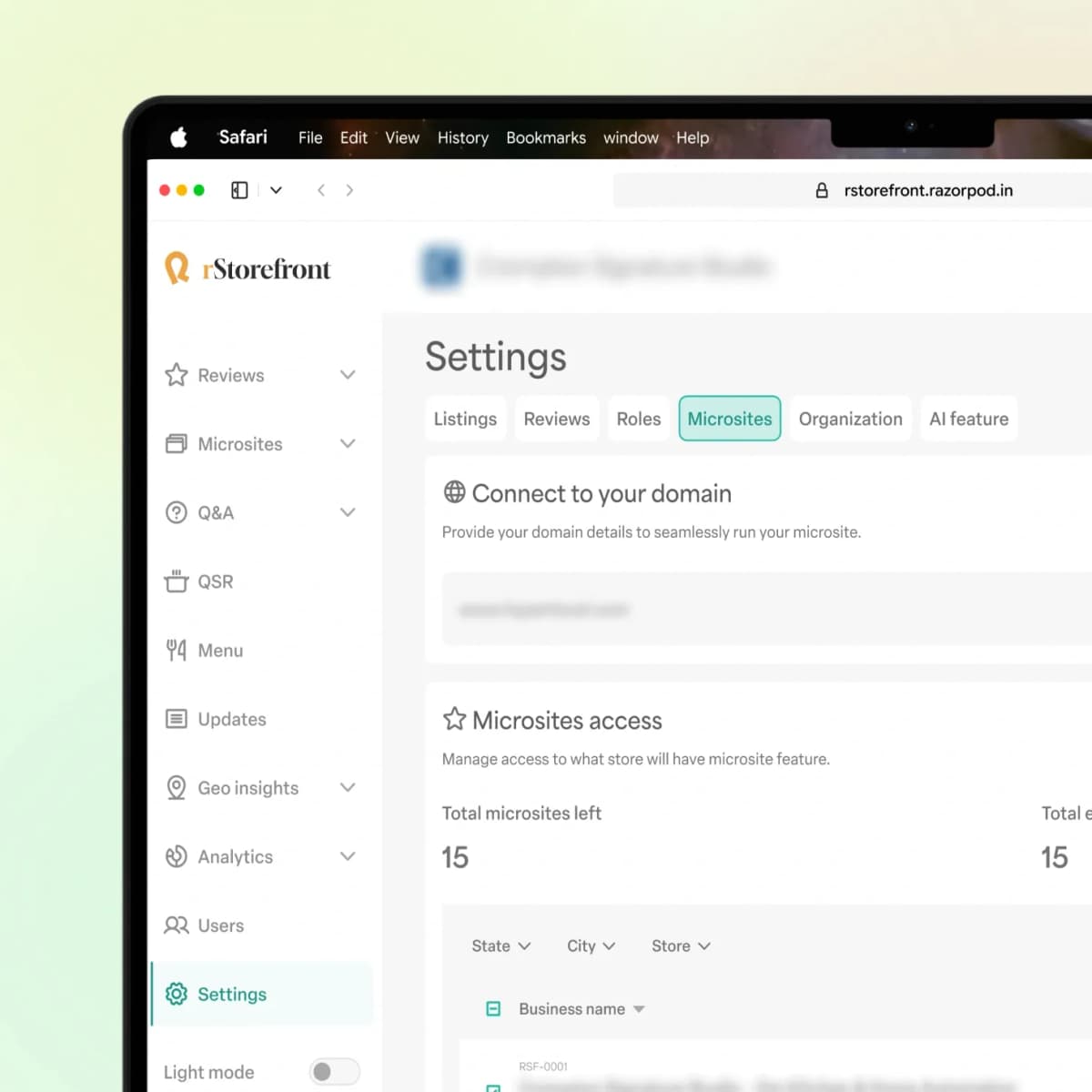
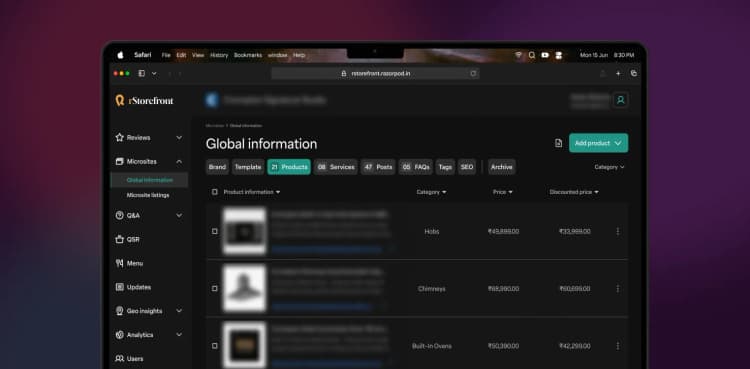
Some categories don't need a microsite per store. Others can't function without one. Real estate. Auto dealerships. Multi-brand showrooms. Anywhere customers want to verify a store's specifics before visiting.
Some categories don't need a microsite per store. Others can't function without one. Real estate. Auto dealerships. Multi-brand showrooms. Anywhere customers want to verify a store's specifics before visiting.
Some categories don't need a microsite per store. Others can't function without one. Real estate. Auto dealerships. Multi-brand showrooms. Anywhere customers want to verify a store's specifics before visiting.
Some categories don't need a microsite per store. Others can't function without one. Real estate. Auto dealerships. Multi-brand showrooms. Anywhere customers want to verify a store's specifics before visiting.
01
90% or more of their stores have a published microsite. Selective uptake across the customer base, deep usage where adopted.
02
90% or more of their stores have a published microsite. Selective uptake across the customer base, deep usage where adopted.




How we built this.
CX Strategy & Transformation, Experience Design, Product Engineering, Personalization Services, Artificial Intelligence, Marketing Technology, Data & Analytics.
Working on something like this?
This is what a full CX engagement looks like. Research, strategy, design, and build. Working on something similar? Let's talk.
Building analytics across four versions, and a grid for where you're invisible
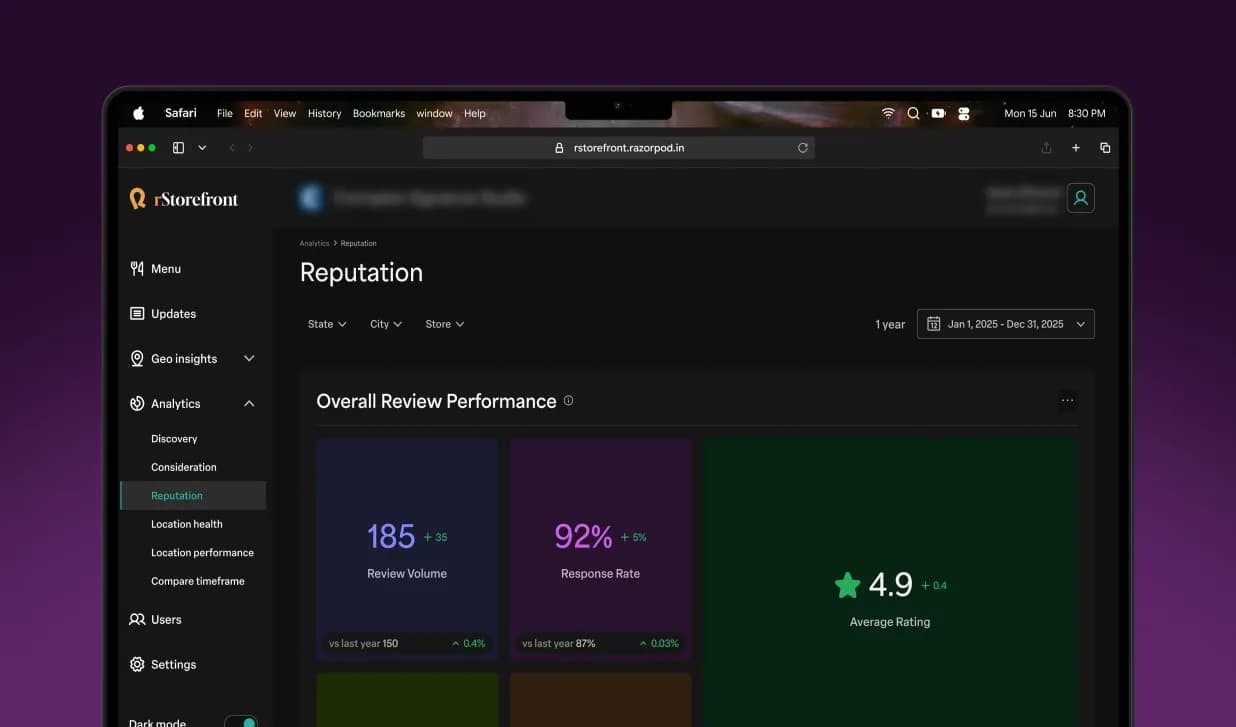
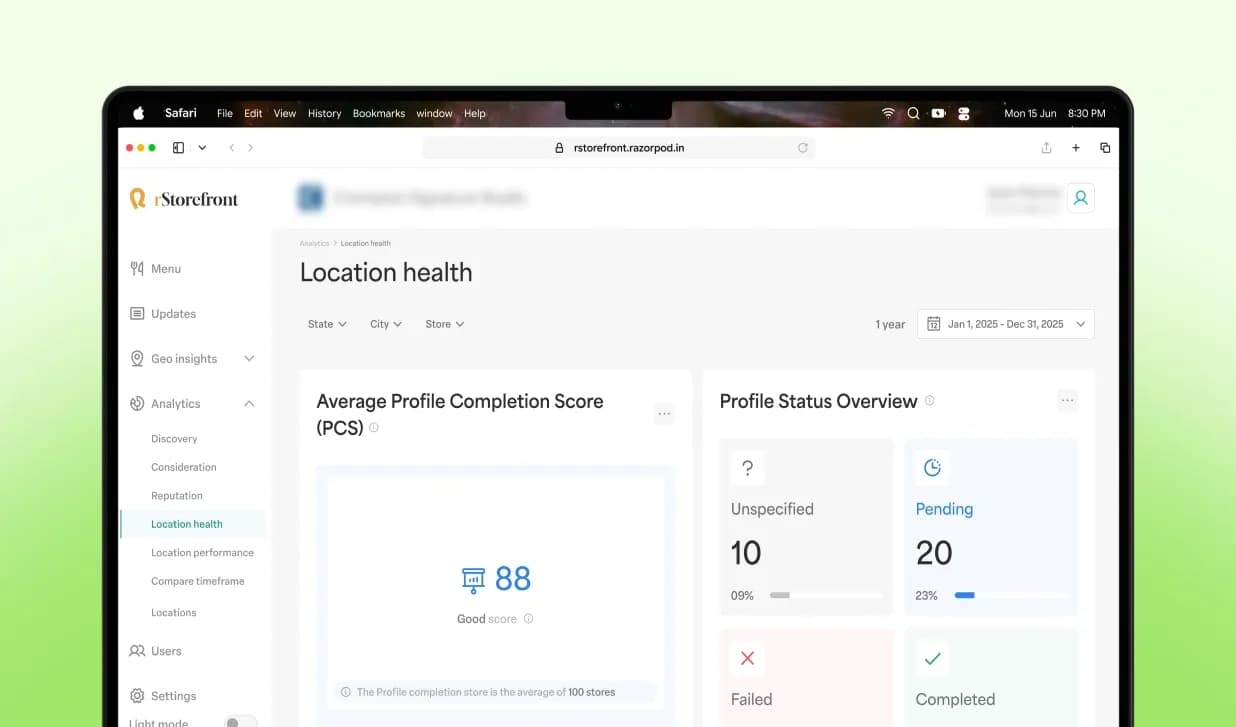
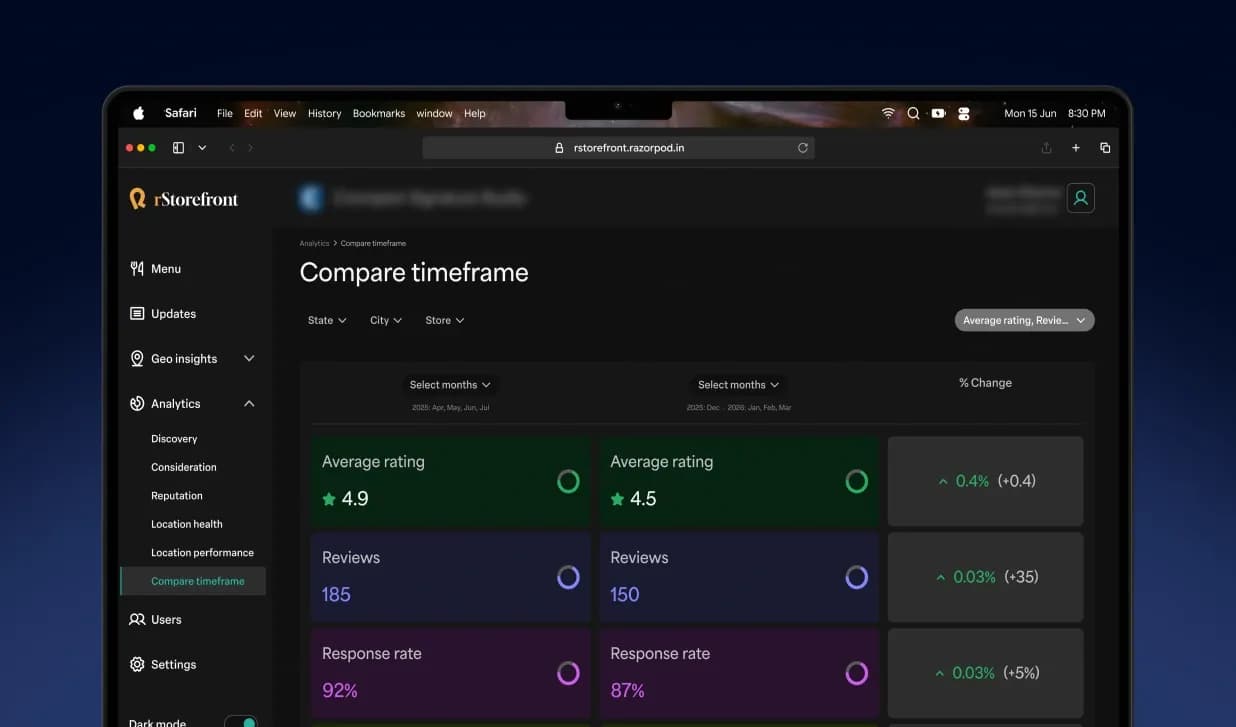
Analytics in rStorefront has been rebuilt four times across the engagement. Each version answered a different question.
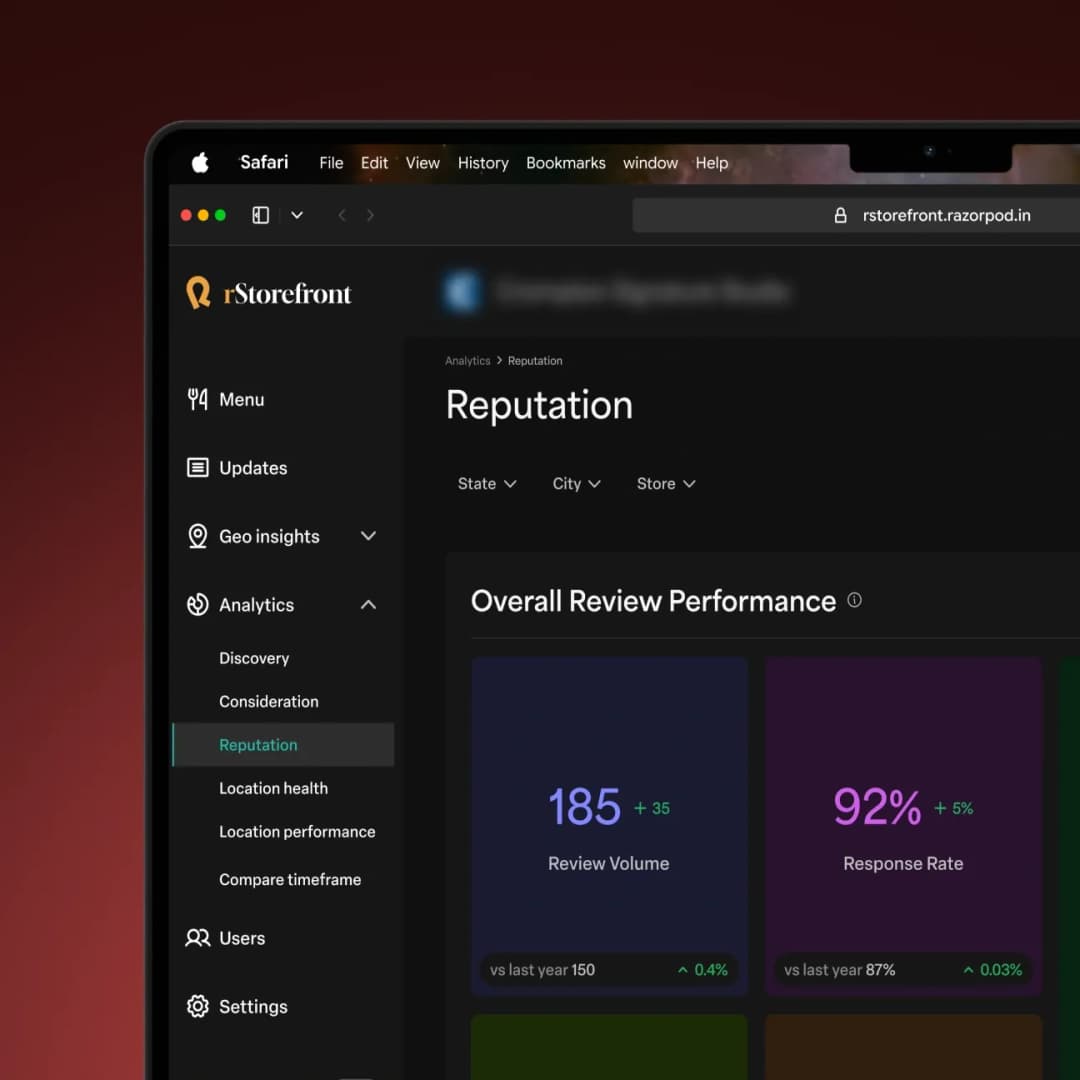
“ v1 made the data legible. v2 made it filterable. v3 reorganised the dashboard into named modules: Discovery, Consideration, Reputation, Location Health, Location Performance. v4 sharpened Discovery and Location Performance, the two surfaces customers used most. ”
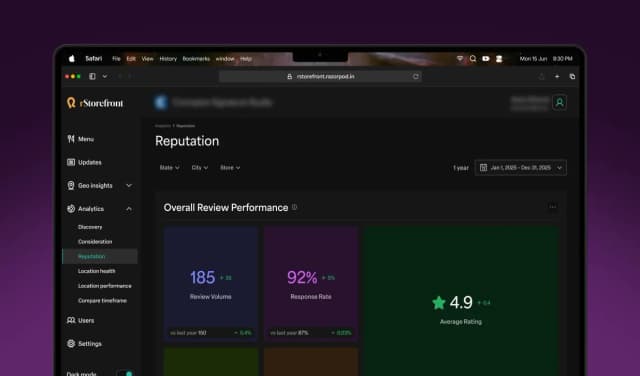
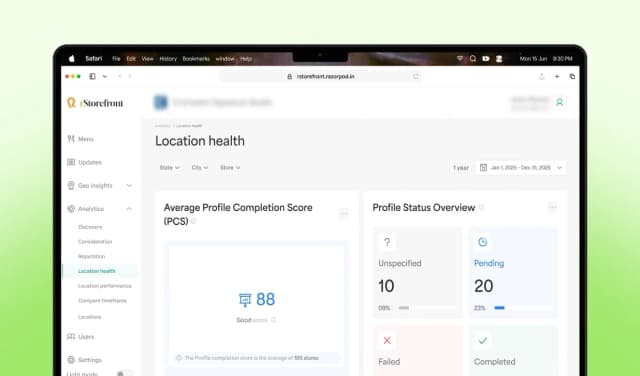
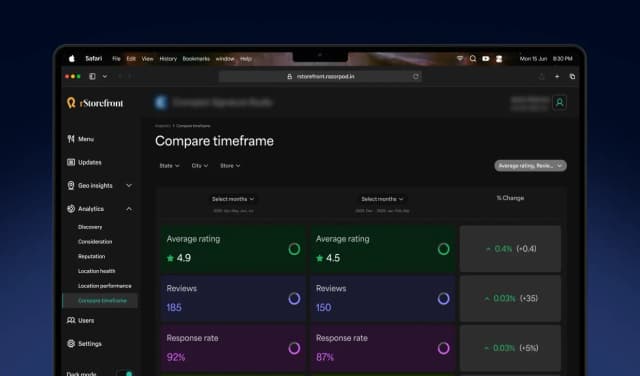
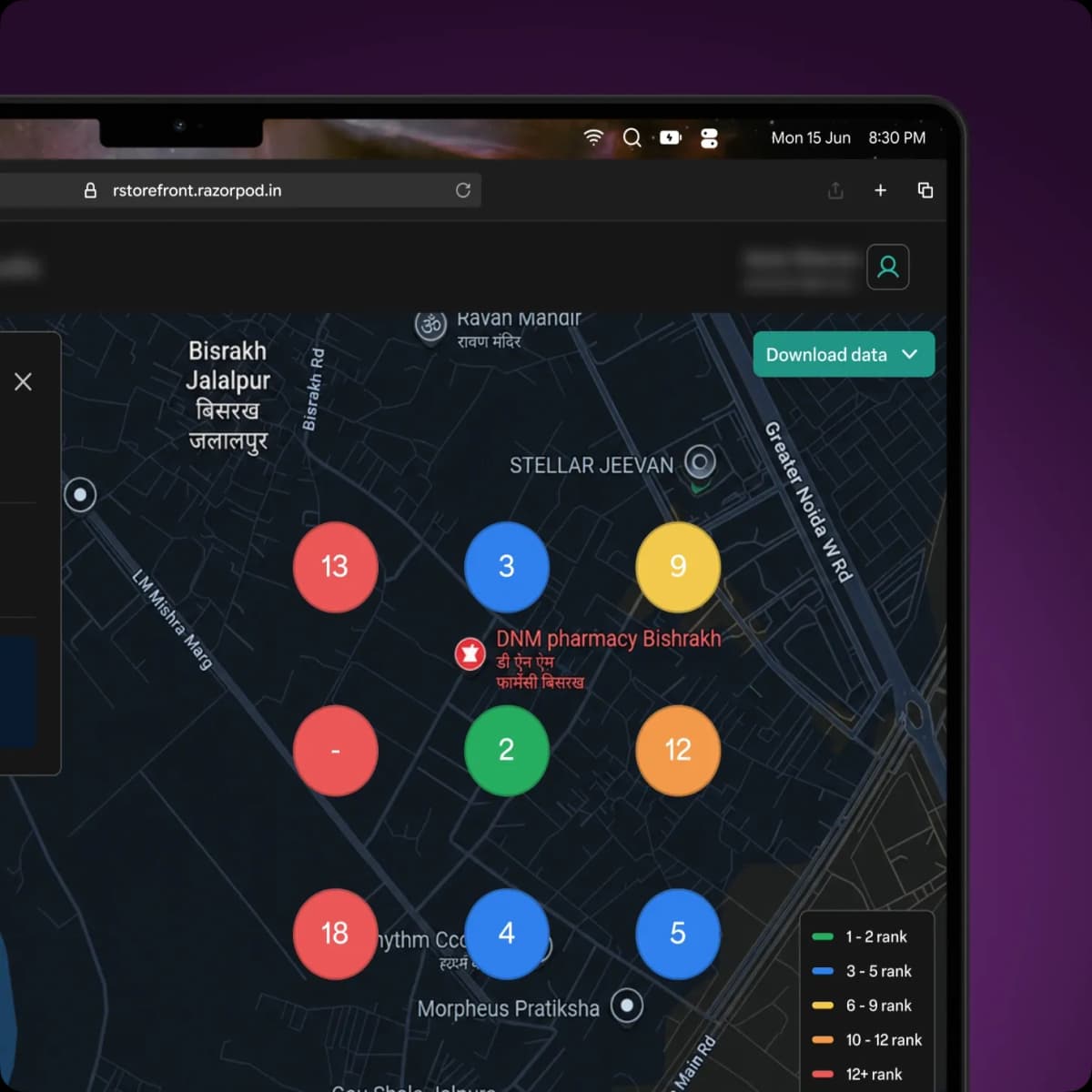
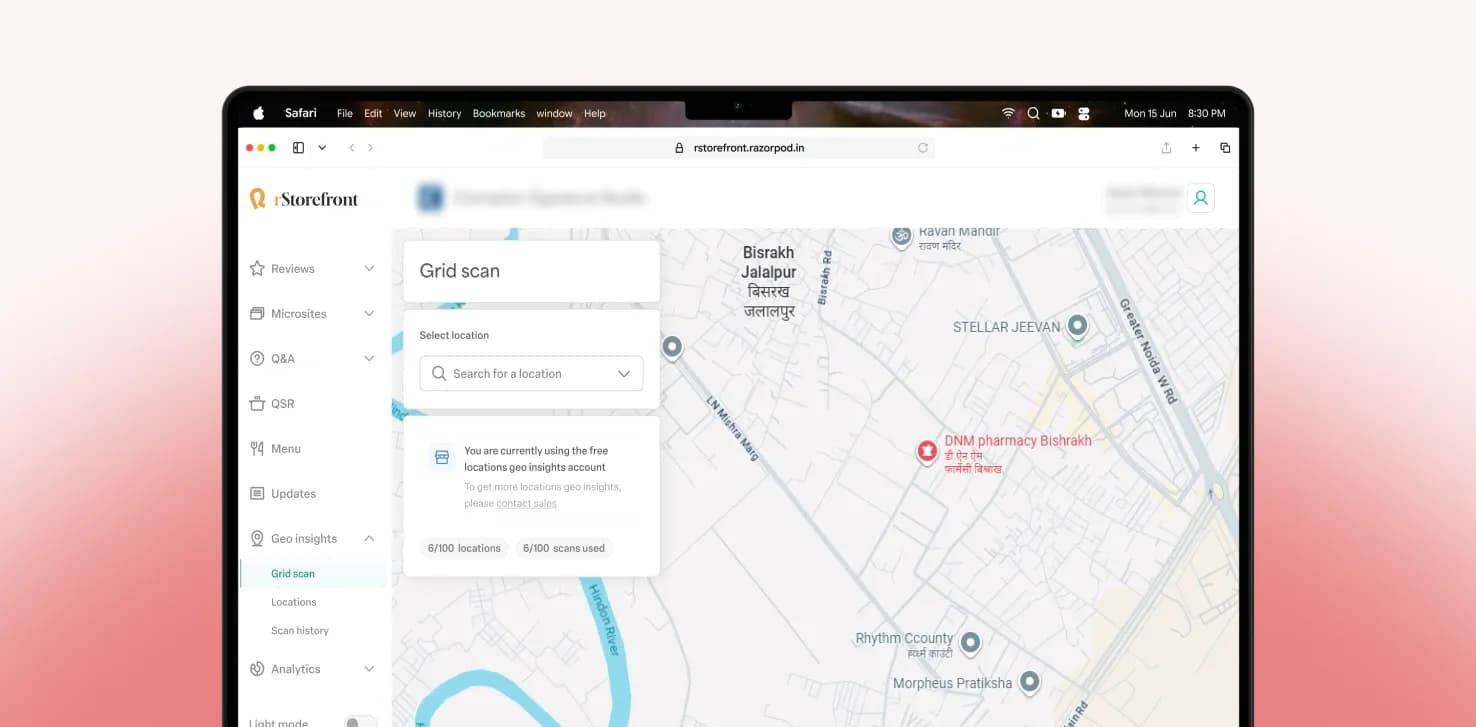
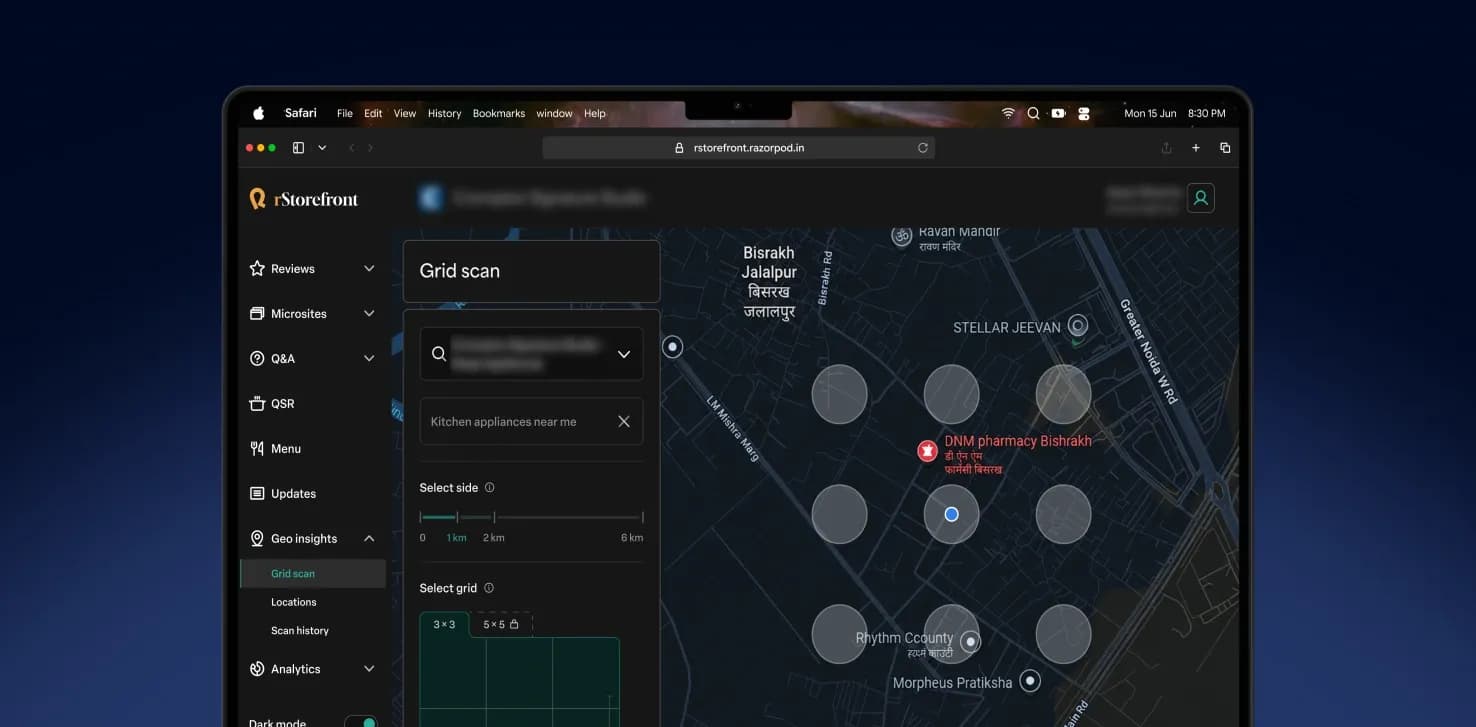
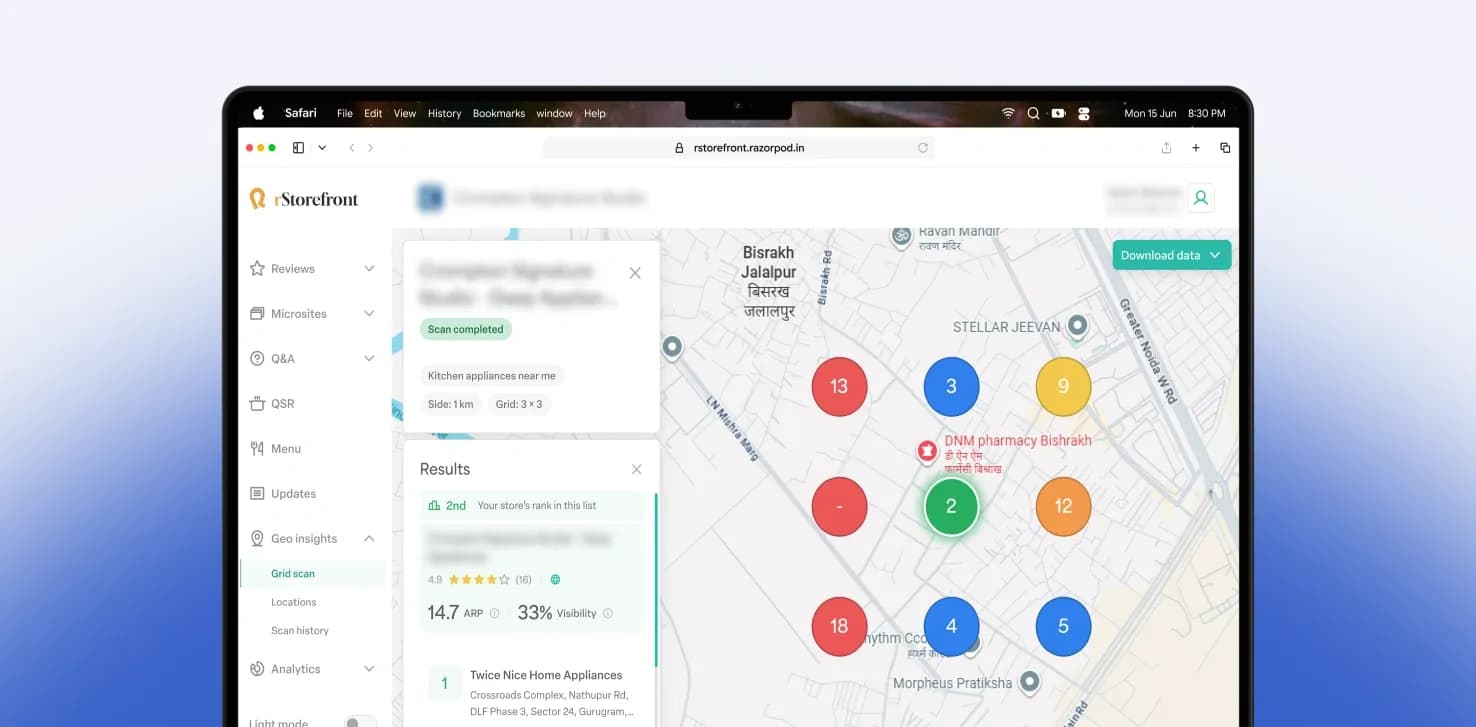
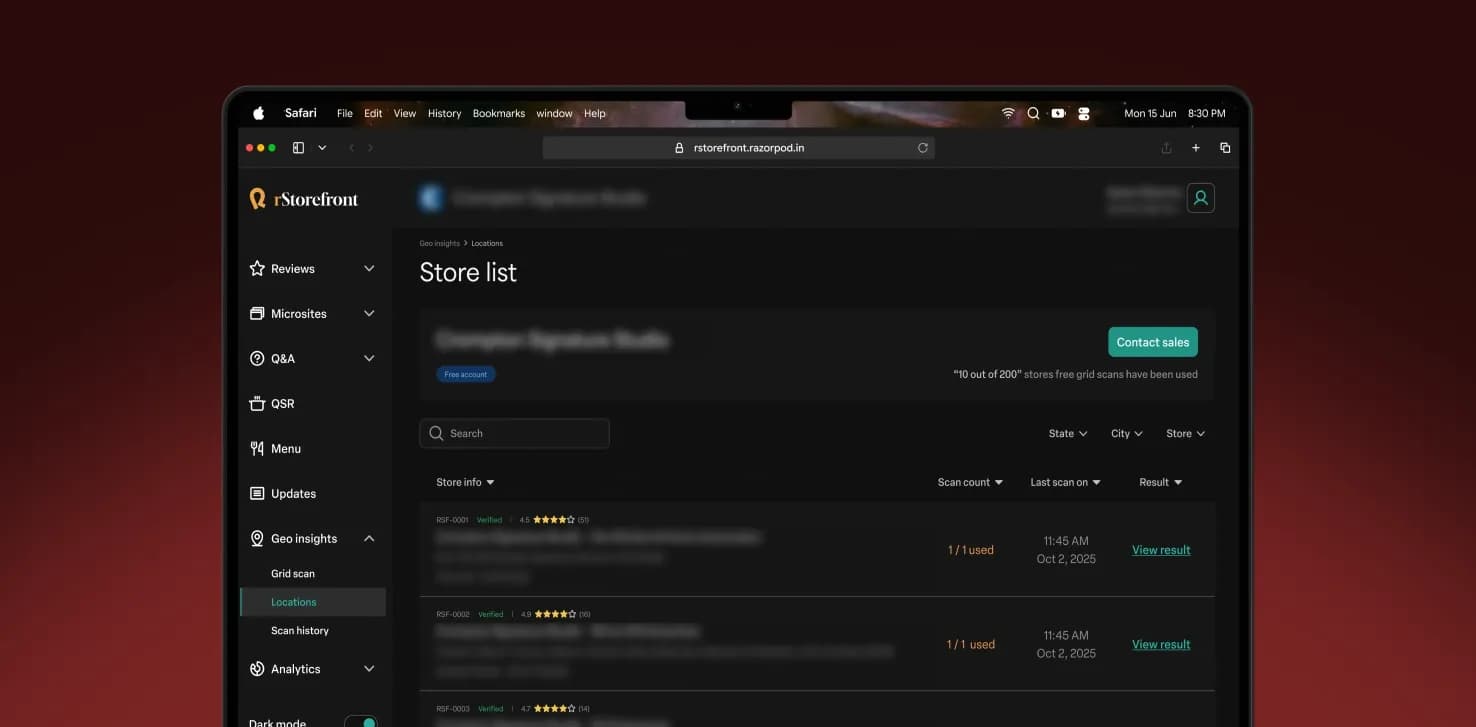
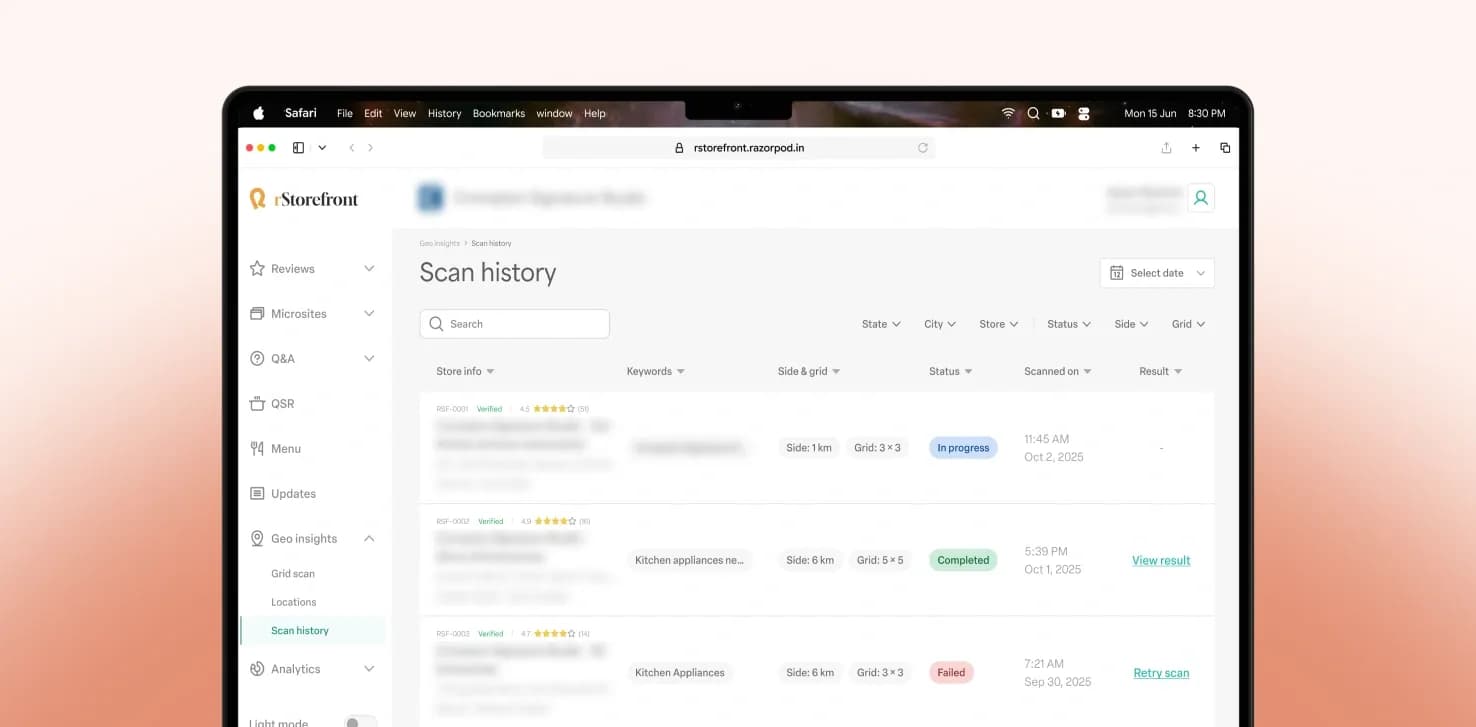
Geo Insights sits alongside Analytics as a separate capability. A grid scan visualises a store's Google Maps visibility across the surrounding neighbourhood, colour-coded by ranking. The category isn't unique to rStorefront, but customers who turn it on use it heavily. Heavy users open the grid scan multiple times a day to optimise specific locations.
Geo Insights
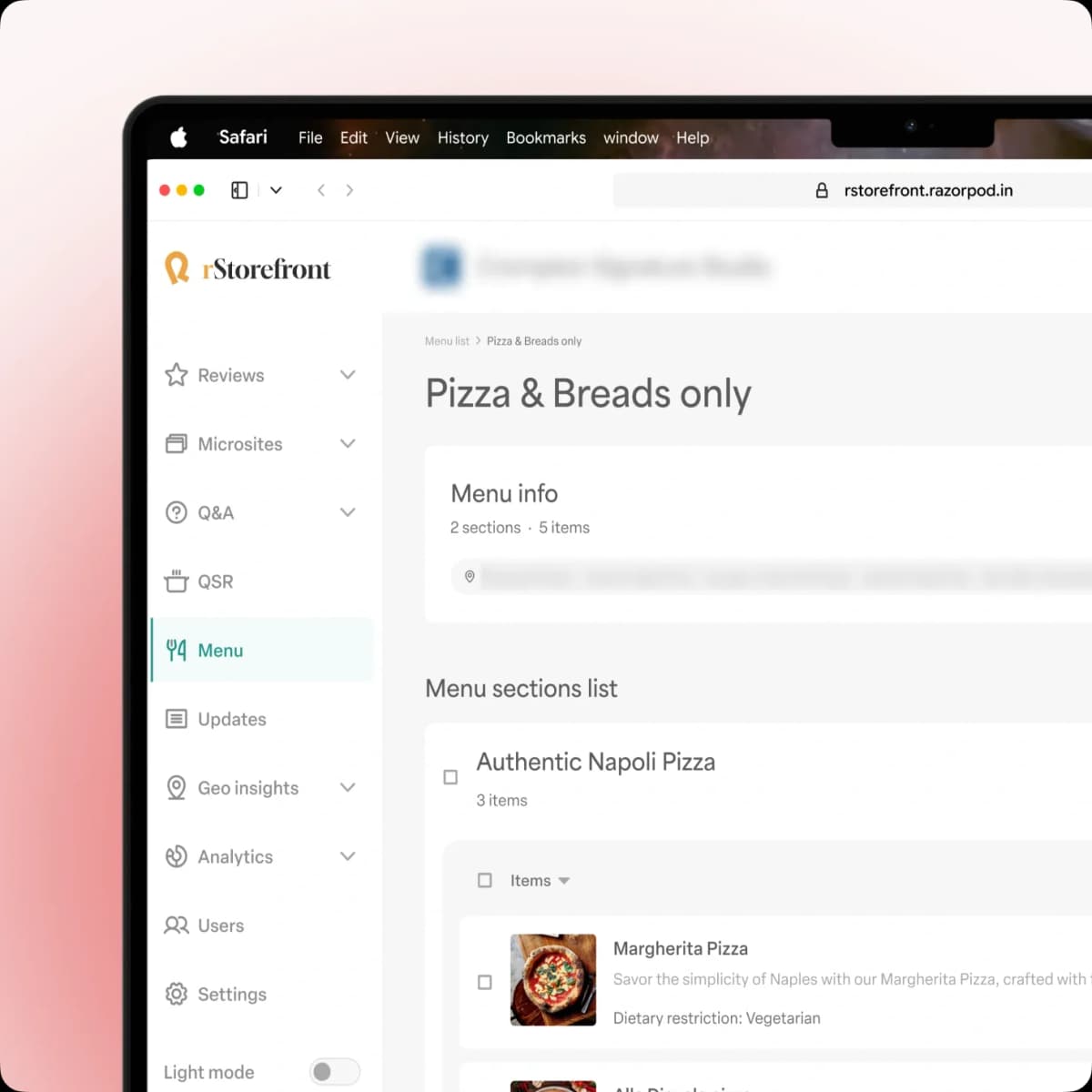
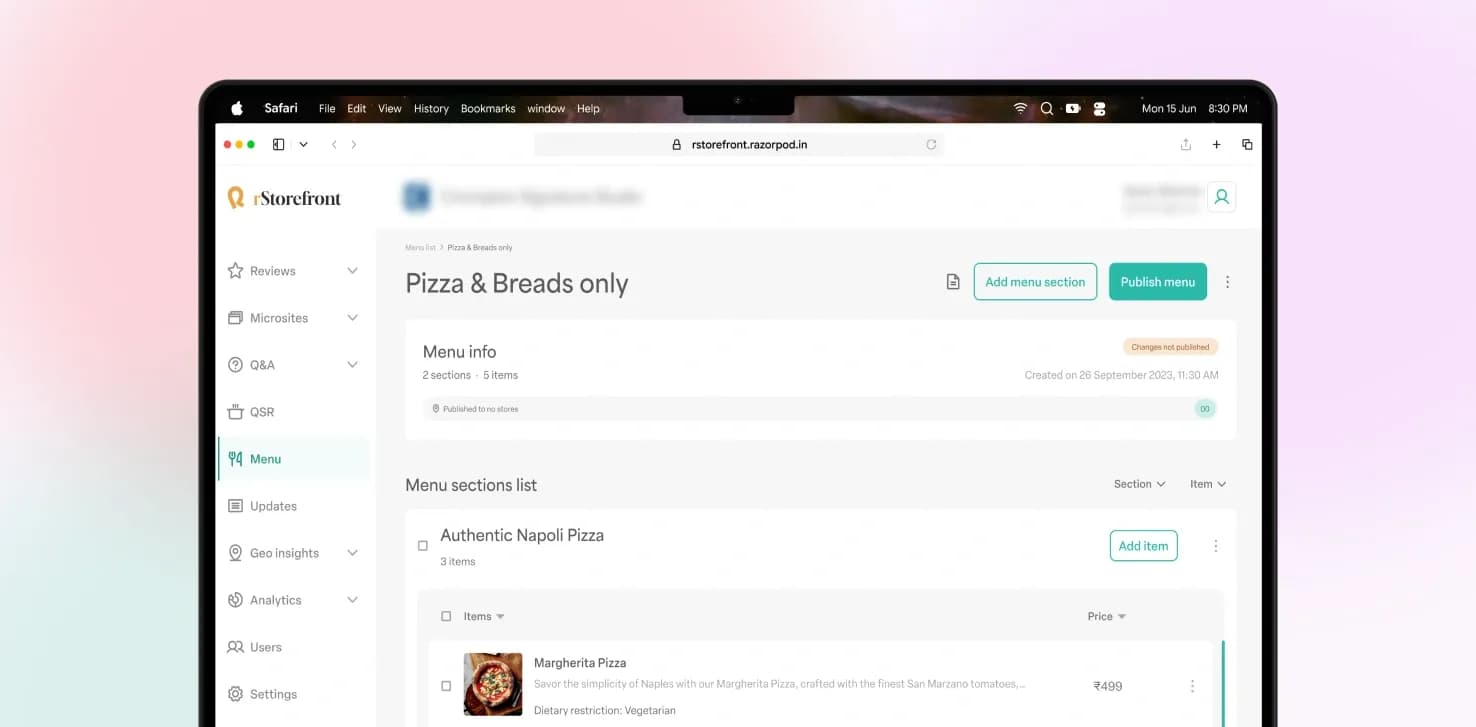
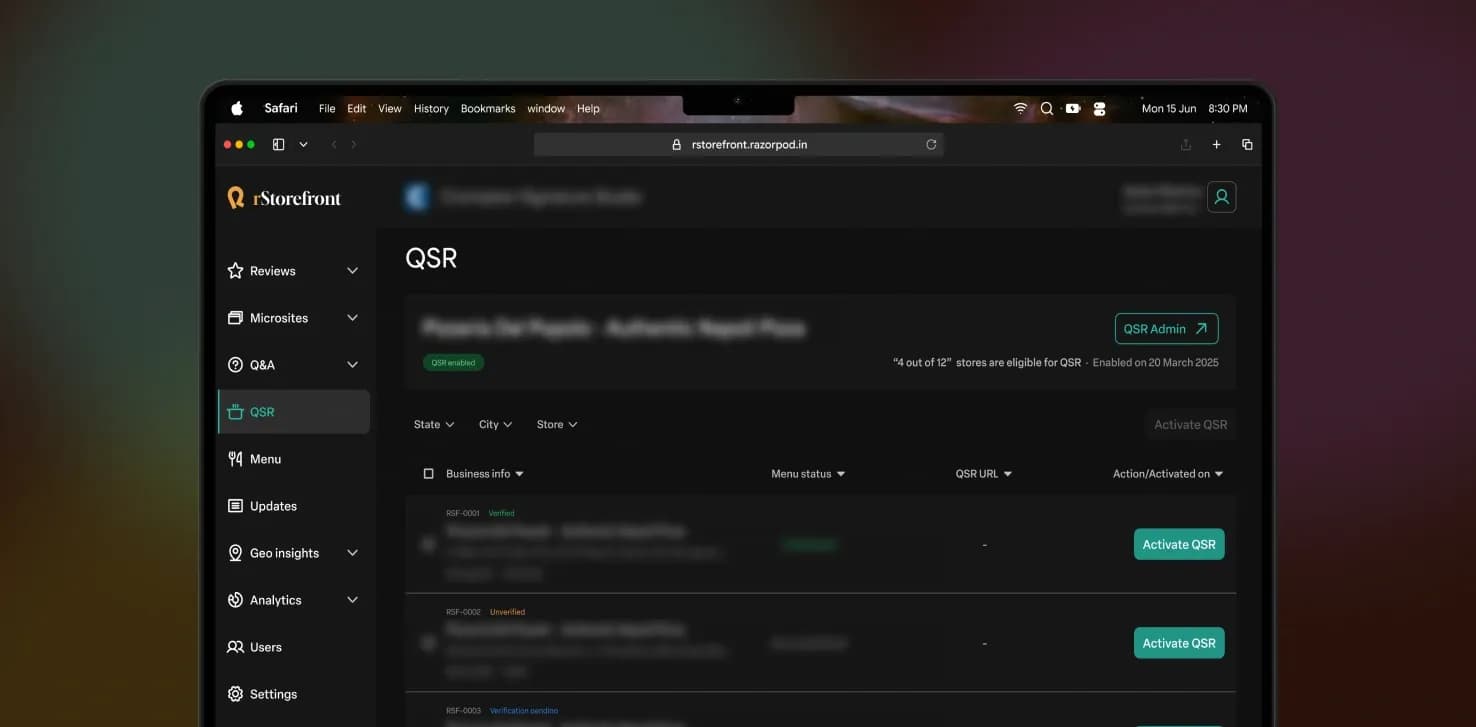
Verticalising because food service isn't electronics
Multi-location brands aren't a single market. A QSR chain manages menu items, photos, and store-level pricing in ways an electronics retailer doesn't. rStorefront added vertical-specific capability when the customer base demanded it.
Multi-location brands aren't a single market. A QSR chain manages menu items, photos, and store-level pricing in ways an electronics retailer doesn't. rStorefront added vertical-specific capability when the customer base demanded it.
Multi-location brands aren't a single market. A QSR chain manages menu items, photos, and store-level pricing in ways an electronics retailer doesn't. rStorefront added vertical-specific capability when the customer base demanded it.
Building a system the next pillar inherits
Building a multi-pillar product across years requires a design system that holds together. Tokens that survive redesigns. Components that compose without rewrites. A library the next surface inherits, not duplicates.
132 primitive variables feed 327 semantic tokens, each mapped across light and dark themes.
132 primitive variables feed 327 semantic tokens, each mapped across light and dark themes.
132 primitive variables feed 327 semantic tokens, each mapped across light and dark themes.
132 primitive variables feed 327 semantic tokens, each mapped across light and dark themes.
The library was the substrate for every pillar. New surfaces inherited rather than reinvented. Iteration on a component propagated across the product. Light and dark shipped from the start, ready for any additional theme without rebuilding the system.
The library was the substrate for every pillar. New surfaces inherited rather than reinvented. Iteration on a component propagated across the product. Light and dark shipped from the start, ready for any additional theme without rebuilding the system.
Complete design system
Built together, and going wider
The product wasn't handed over. It was built together.
“ OneCX was in the room when the platform was conceived. We shaped what got built, sprint by sprint, year by year. Strategy and execution didn't sit in separate phases handed off between teams. They moved together, with the Razorlabs product and engineering team as full partners. ”
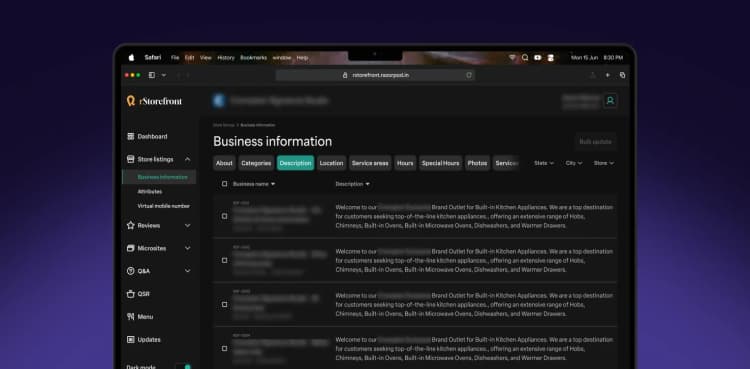
rStorefront, a reputation management platform
rStorefront serves 20+ Indian brands today. Global expansion is the next chapter. New verticals beyond food service are in scope as customer concentration grows. The platform is going where the partnership built it to go.
Outcome statements
For marketing stakeholders

Profile completeness averaging 93% across listings managed.

Profile completeness averaging 93% across listings managed.
Profile completeness averaging 93% across listings managed.
For CTO/CPO
Multi-pillar platform: Listings, Reviews, Microsites, VMN, Analytics, + AI & vertical layers.
Multi-pillar platform: Listings, Reviews, Microsites, VMN, Analytics, + AI & vertical layers.
Product deliveries
One bulk engine that edits 400+ listings in a single action.
One bulk engine that edits 400+ listings in a single action.
The five pillars and capability layers
Listings
Every GMB profile in one place, editable per store or in bulk.
Reviews
All the reviews, with sentiment, segmentation, and much more.
Microsites
A per-store website published from a central editor.
Virtual Mobile Number
Dedicated number per store with attribution.
Analytics
Cross-pillar performance, across all the stores.
AI Responder
AI-drafted review replies inline in the reviews table.
Geo Insights
Map-grid visibility for any store across its neighbourhood.
Vertical activation
Menu Module & QSR onboarding for food service.
Customer footprint
Industries served (anonymised): consumer appliances, electric mobility, government-backed marketplaces, food service, real estate, and others. Pan-India today. Global expansion next.
Design system detail
132 primitive variables, 327 semantic tokens, mapped across light and dark themes.
132 primitive variables, 327 semantic tokens, mapped across light and dark themes.
132 primitive variables, 327 semantic tokens, mapped across light and dark themes.
~50 component sets across primitives and composites.
~50 component sets across primitives and composites.
~50 component sets across primitives and composites.
Capability layers detail
- AI Responder: Inline review reply drafts, adapting to sentiment, category, and brand tone. Shipped before Google's native equivalent.
- Geo Insights: Colour-coded grid heatmap of a store's Maps visibility across its neighbourhood. Heavy users open it multiple times a day.
- Menu Module: Cross-store menu management with structured groups, items, pricing tiers, photos, availability windows. v2 includes ingredient-level metadata.
- QSR Activation: Verticalised onboarding bundling listings, microsite, menu, and reviews for food service brands.
Project
Website
Industry
Category
Year
Author
Recommended case studies
Religare Broking
Jul 01, 2026
·
32 mins read
SUD Life


Jul 01, 2026
·
5 mins read




Your Product Deserves UX That Gets Smarter Every Sprint.